Skip to article frontmatterSkip to article content
Site not loading correctly?

This may be due to an incorrect BASE_URL configuration. See the MyST Documentation for reference.

Because sometimes your model needs fewer features and more self-control. 😌


🎯 Why Regularize?

So far, we’ve made our regression models smarter and curvier with polynomial features. But now they’ve become… too enthusiastic. 😅

They start memorizing the training data like:

“Oh, you sneezed near the marketing budget last quarter? Let me model that too!” 🤧📉

That’s called overfitting — when your model learns the noise instead of the trend.

Enter Regularization — the art of teaching models self-restraint. It penalizes extreme coefficients, making the model simpler and more generalizable.


🧮 The Regularized Loss Function

The usual regression loss (Mean Squared Error) is:

[ J(\beta) = \frac{1}{n}\sum_{i=1}^{n}(y_i - \hat{y}_i)^2 ]

With regularization, we add a penalty for large weights (β’s):

[ J(\beta) = \frac{1}{n}\sum_{i=1}^{n}(y_i - \hat{y}_i)^2 + \lambda \times \text{Penalty} ]

Where:

  • ( \lambda ) (lambda) = regularization strength

    • Small λ → “Do whatever you want” (no restriction)

    • Large λ → “Calm down and stop exaggerating, β!”


🏋️‍♀️ Ridge Regression (L2 Regularization)

[ \text{Penalty} = \sum_{j=1}^{p} \beta_j^2 ]

  • Penalizes large weights smoothly

  • Never makes coefficients zero — just shrinks them

  • Think of it as model yoga 🧘‍♀️: flexible, controlled, balanced

from sklearn.linear_model import Ridge
ridge = Ridge(alpha=1.0)
ridge.fit(X_train, y_train)

Ridge says: “You can keep all your features, but don’t let any of them get too cocky.” 😎


✂️ Lasso Regression (L1 Regularization)

[ \text{Penalty} = \sum_{j=1}^{p} |\beta_j| ]

  • Can actually make some coefficients exactly zero

  • Performs automatic feature selection

  • Think of it as the strict boss 👩‍💼 who fires underperforming variables

from sklearn.linear_model import Lasso
lasso = Lasso(alpha=0.1)
lasso.fit(X_train, y_train)

Lasso says: “If you don’t contribute to reducing error, you’re out.” 💼🚪


⚖️ Elastic Net (L1 + L2 Hybrid)

Elastic Net is the compromise manager between Ridge and Lasso:

[ \text{Penalty} = \alpha_1 \sum |\beta_j| + \alpha_2 \sum \beta_j^2 ]

  • Keeps Ridge’s stability

  • Adds Lasso’s feature selection

  • Perfect for correlated features or when you want balance

from sklearn.linear_model import ElasticNet
elastic = ElasticNet(alpha=0.1, l1_ratio=0.5)
elastic.fit(X_train, y_train)

Elastic Net: “I’m not too soft like Ridge or too harsh like Lasso — I’m HR-approved.” 😌📊


📊 Visual Comparison of Penalties

TypePenaltyEffect on CoefficientsAnalogy
Ridge( \sum \beta^2 )Shrinks but keeps allYoga 🧘‍♀️
Lasso( \sum\beta)Sets some to zeroBoss firing lazy staff 👩‍💼
Elastic NetMix of bothBalanced shrinkageHR mediation 🤝

💼 Business Analogy

Let’s say you’re running a marketing campaign with 20 possible channels:

  • TV, Radio, YouTube, Instagram, SEO, Billboards, TikTok... (you name it).

If you use plain regression, it’ll assign crazy weights — maybe TikTok gets 80% importance 🤦‍♂️.

Regularization steps in:

  • Ridge: “All channels matter, but tone them down.”

  • Lasso: “Let’s drop the useless ones (bye, billboards 👋).”

  • Elastic Net: “Some balance — keep the core few strong, others moderate.”


🧩 Hands-On Example

import numpy as np
from sklearn.linear_model import LinearRegression, Ridge, Lasso
from sklearn.model_selection import train_test_split
from sklearn.metrics import mean_squared_error

# Generate toy data
np.random.seed(42)
X = np.random.randn(100, 5)
y = X[:, 0]*3 + X[:, 2]*2 + np.random.randn(100)

X_train, X_test, y_train, y_test = train_test_split(X, y, test_size=0.2)

models = {
    "Linear": LinearRegression(),
    "Ridge": Ridge(alpha=1.0),
    "Lasso": Lasso(alpha=0.1)
}

for name, model in models.items():
    model.fit(X_train, y_train)
    y_pred = model.predict(X_test)
    print(f"{name}: MSE={mean_squared_error(y_test, y_pred):.3f}, Coeffs={model.coef_}")

Watch how Lasso ruthlessly zeroes out some coefficients, while Ridge politely reduces their values.


⚠️ Choosing the Right λ (alpha)

Regularization strength matters — too much or too little ruins the model.

λ (alpha)Effect
0No regularization (pure OLS)
SmallLight shrinkage
LargeHeavy shrinkage, underfitting
ExtremeModel gives up (predicts mean for everything 😵)

Best practice? Use cross-validation (like RidgeCV, LassoCV) to find your sweet spot.


📚 Python Refresher

Not comfy with NumPy or scikit-learn syntax yet? 👉 Visit Programming for Business It’ll help you get fluent in Python basics before mastering machine learning magic. 🐍💼


🧭 Recap

ConceptDescription
RidgePenalizes large weights (L2)
LassoPenalizes absolute weights (L1), can zero out features
Elastic NetHybrid of L1 + L2
Regularization Strength (λ)Controls shrinkage intensity
GoalReduce overfitting, improve generalization

💬 Final Thought

“Regularization is like budgeting for your model — if you give it unlimited freedom, it’ll overspend on nonsense.” 💸📉


🔜 Next Up

🎯 Bias–Variance Tradeoff where we’ll learn how to balance simplicity and accuracy — like every great business strategist (or data scientist) must. ⚖️📊


from sklearn.preprocessing import StandardScaler
from sklearn.pipeline import make_pipeline
from sklearn.preprocessing import PolynomialFeatures
from sklearn.linear_model import LinearRegression
import numpy as np
import matplotlib.pyplot as plt

# Generate some sample data for demonstration
np.random.seed(42)
m = 100
X = 6 * np.random.rand(m, 1) - 3
y = 0.5 * X**2 + X + 2 + np.random.randn(m, 1)

# Create data for plotting the predictions
X_new = np.linspace(-3, 3, 100).reshape(-1, 1)

plt.figure(figsize=(10, 6))

for style, width, degree in (("r-+", 2, 1), ("b--", 2, 2), ("g-", 1, 10), ("m", 1, 20)):
    polybig_features = PolynomialFeatures(degree=degree, include_bias=False)
    std_scaler = StandardScaler()
    lin_reg = LinearRegression()
    polynomial_regression = make_pipeline(polybig_features, std_scaler, lin_reg)
    polynomial_regression.fit(X, y)
    y_newbig = polynomial_regression.predict(X_new)
    label = f"{degree} degree{'s' if degree > 1 else ''}"
    plt.plot(X_new, y_newbig, style, label=label, linewidth=width)

plt.plot(X, y, "b.", linewidth=3, label="Training Data")
plt.legend(loc="upper left")
plt.xlabel("$x_1$")
plt.ylabel("$y$", rotation=0)
plt.title("Polynomial Regression with Different Degrees")
plt.grid(True)
plt.show()
/Users/chandraveshchaudhari/Desktop/JupyterNotebooks/.venv/lib/python3.12/site-packages/sklearn/linear_model/_base.py:281: RuntimeWarning: divide by zero encountered in matmul
  return X @ coef_.T + self.intercept_
/Users/chandraveshchaudhari/Desktop/JupyterNotebooks/.venv/lib/python3.12/site-packages/sklearn/linear_model/_base.py:281: RuntimeWarning: overflow encountered in matmul
  return X @ coef_.T + self.intercept_
/Users/chandraveshchaudhari/Desktop/JupyterNotebooks/.venv/lib/python3.12/site-packages/sklearn/linear_model/_base.py:281: RuntimeWarning: invalid value encountered in matmul
  return X @ coef_.T + self.intercept_
<Figure size 1000x600 with 1 Axes>
from sklearn.preprocessing import StandardScaler
from sklearn.pipeline import make_pipeline
from sklearn.preprocessing import PolynomialFeatures
from sklearn.linear_model import LinearRegression
import numpy as np
import matplotlib.pyplot as plt

# Generate some sample data for demonstration
np.random.seed(42)
m = 100
X = 6 * np.random.rand(m, 1) - 3
y = 0.5 * X**2 + X + 2 + np.random.randn(m, 1)

# Create data for plotting the predictions
X_new = np.linspace(-3, 3, 100).reshape(-1, 1)

plt.figure(figsize=(10, 6))

for style, width, degree in (("r-+", 2, 30),):
    polybig_features = PolynomialFeatures(degree=degree, include_bias=False)
    std_scaler = StandardScaler()
    lin_reg = LinearRegression()
    polynomial_regression = make_pipeline(polybig_features, std_scaler, lin_reg)
    polynomial_regression.fit(X, y)
    y_newbig = polynomial_regression.predict(X_new)
    label = f"{degree} degree{'s' if degree > 1 else ''}"
    plt.plot(X_new, y_newbig, style, label=label, linewidth=width)

plt.plot(X, y, "b.", linewidth=3, label="Training Data")
plt.legend(loc="upper left")
plt.xlabel("$x_1$")
plt.ylabel("$y$", rotation=45)
plt.title("Polynomial Regression with Different Degrees")
plt.grid(True)

# Set only the y-axis limits to 0-10
plt.ylim(0, 10)

plt.tight_layout()
plt.show()
/Users/chandraveshchaudhari/Desktop/JupyterNotebooks/.venv/lib/python3.12/site-packages/sklearn/linear_model/_base.py:281: RuntimeWarning: divide by zero encountered in matmul
  return X @ coef_.T + self.intercept_
/Users/chandraveshchaudhari/Desktop/JupyterNotebooks/.venv/lib/python3.12/site-packages/sklearn/linear_model/_base.py:281: RuntimeWarning: overflow encountered in matmul
  return X @ coef_.T + self.intercept_
/Users/chandraveshchaudhari/Desktop/JupyterNotebooks/.venv/lib/python3.12/site-packages/sklearn/linear_model/_base.py:281: RuntimeWarning: invalid value encountered in matmul
  return X @ coef_.T + self.intercept_
<Figure size 1000x600 with 1 Axes>

Generalization, Overfitting, and Regularization

  1. Underfitting vs Overfitting

Conceptual Overview • Underfitting occurs when the model is too simple to capture the underlying trend. • Overfitting happens when the model is too complex and captures noise in the training data. • Good Generalization balances complexity and accuracy on unseen data.

Graphical Representation


import numpy as np
import matplotlib.pyplot as plt
from sklearn.linear_model import LinearRegression
from sklearn.preprocessing import PolynomialFeatures

# Generate sample data
np.random.seed(0)
X = np.sort(5 * np.random.rand(80, 1), axis=0)
y = np.sin(X).ravel() + np.random.normal(0, 0.2, X.shape[0])

# Models of different complexity
degrees = [1, 4, 15]
plt.figure(figsize=(15, 4))

for i, d in enumerate(degrees):
    poly = PolynomialFeatures(degree=d)
    X_poly = poly.fit_transform(X)
    model = LinearRegression().fit(X_poly, y)
    y_pred = model.predict(X_poly)

    plt.subplot(1, 3, i+1)
    plt.scatter(X, y, color='black', label='Data')
    plt.plot(X, y_pred, color='red', label=f'Degree {d}')
    plt.title(['Underfitting', 'Good Fit', 'Overfitting'][i])
    plt.legend()

plt.tight_layout()
plt.show()
/Users/chandraveshchaudhari/Desktop/JupyterNotebooks/.venv/lib/python3.12/site-packages/sklearn/linear_model/_base.py:279: RuntimeWarning: divide by zero encountered in matmul
  return X @ coef_ + self.intercept_
/Users/chandraveshchaudhari/Desktop/JupyterNotebooks/.venv/lib/python3.12/site-packages/sklearn/linear_model/_base.py:279: RuntimeWarning: overflow encountered in matmul
  return X @ coef_ + self.intercept_
/Users/chandraveshchaudhari/Desktop/JupyterNotebooks/.venv/lib/python3.12/site-packages/sklearn/linear_model/_base.py:279: RuntimeWarning: invalid value encountered in matmul
  return X @ coef_ + self.intercept_
<Figure size 1500x400 with 3 Axes>

  1. Mathematical Formulation

Let training error be:

MSEtrain=1ni=1n(yiy^i)2\text{MSE}{train} = \frac{1}{n} \sum{i=1}^n (y_i - \hat{y}_i)^2
•	Underfitting: High training and validation error.
•	Overfitting: Low training error, high validation error.
•	Generalization: Low validation error, good performance on unseen data.

Bias-Variance Tradeoff: A Mathematical Understanding

1. Introduction

The bias-variance tradeoff is a fundamental concept in machine learning that explains the relationship between a model’s complexity, its error on training data, and its ability to generalize to new data. Understanding this tradeoff helps us build models that balance underfitting and overfitting.

2. Mathematical Decomposition of Error

For any supervised learning problem, we can decompose the expected prediction error into three components:

E[(yf^(x))2]=Bias2+Variance+Irreducible Error\mathbb{E}[(y - \hat{f}(x))^2] = \text{Bias}^2 + \text{Variance} + \text{Irreducible Error}

Where:

  • yy is the true target value

  • f^(x)\hat{f}(x) is our model’s prediction

  • E\mathbb{E} represents the expected value

3. Understanding Each Component

3.1. Bias

Bias measures how far off our predictions are from the true values on average.

Bias[f^(x)]=E[f^(x)]f(x)\text{Bias}[\hat{f}(x)] = \mathbb{E}[\hat{f}(x)] - f(x)

Where f(x)f(x) is the true underlying function we’re trying to approximate.

High bias indicates that our model is making systematic errors - it’s consistently missing the target. This typically happens when the model is too simple to capture the underlying pattern in the data (underfitting).

3.2. Variance

Variance measures how much our model’s prediction would fluctuate if we trained it on different training datasets.

Variance[f^(x)]=E[(f^(x)E[f^(x)])2]\text{Variance}[\hat{f}(x)] = \mathbb{E}[(\hat{f}(x) - \mathbb{E}[\hat{f}(x)])^2]

High variance indicates that our model is highly sensitive to the specific data it was trained on, meaning it’s likely capturing noise rather than the underlying pattern (overfitting).

3.3. Irreducible Error

Irreducible Error=σ2=E[(yf(x))2]\text{Irreducible Error} = \sigma^2 = \mathbb{E}[(y - f(x))^2]

This represents noise in the true relationship that cannot be eliminated by any model.

4. The Tradeoff

The key insight is that as model complexity increases:

  • Bias tends to decrease (the model can represent more complex patterns)

  • Variance tends to increase (the model becomes more sensitive to training data)

This creates a tradeoff where the total error (which is the sum of squared bias, variance, and irreducible error) forms a U-shaped curve when plotted against model complexity.

5. Mathematical Formulation for MSE

For a specific input point x0x_0, the expected mean squared error of a model f^\hat{f} can be mathematically decomposed as:

E[(y0f^(x0))2]=(f(x0)E[f^(x0)])2+E[(f^(x0)E[f^(x0)])2]+σ2\mathbb{E}[(y_0 - \hat{f}(x_0))^2] = (f(x_0) - \mathbb{E}[\hat{f}(x_0)])^2 + \mathbb{E}[(\hat{f}(x_0) - \mathbb{E}[\hat{f}(x_0)])^2] + \sigma^2

Which simplifies to:

E[(y0f^(x0))2]=Bias2+Variance+Irreducible Error\mathbb{E}[(y_0 - \hat{f}(x_0))^2] = \text{Bias}^2 + \text{Variance} + \text{Irreducible Error}

6. Polynomial Regression Example

For polynomial regression of degree dd, we have:

f^d(x)=j=0dβjxj\hat{f}_d(x) = \sum_{j=0}^{d} \beta_j x^j

As dd increases:

  • Bias decreases: Higher degree polynomials can better approximate the true function

  • Variance increases: The model becomes more sensitive to the specific noise patterns in the training data

7. Practical Implications

The total expected test MSE is:

Expected Test MSE=Bias2+Variance+σ2\text{Expected Test MSE} = \text{Bias}^2 + \text{Variance} + \sigma^2

While the training MSE typically continues to decrease as model complexity increases, the test MSE will eventually start increasing due to the variance term growing faster than the bias term decreases.

This is why:

  • Simple models (low complexity): High bias, low variance → Underfitting

  • Complex models (high complexity): Low bias, high variance → Overfitting

  • Optimal models: The right balance between bias and variance → Best generalization

8. Mathematical Visualization

If we plot the error terms against model complexity, we get:

  • Bias2C1complexity\text{Bias}^2 \approx \frac{C_1}{\text{complexity}} (decreases with complexity)

  • VarianceC2complexity\text{Variance} \approx C_2 \cdot \text{complexity} (increases with complexity)

  • Total Error=Bias2+Variance+σ2\text{Total Error} = \text{Bias}^2 + \text{Variance} + \sigma^2 (U-shaped)

Where C1C_1 and C2C_2 are constants.

9. Regularization Perspective

Regularization techniques like L1 and L2 can be viewed as ways to manage this tradeoff. The regularized loss function is:

Lregularized=Lempirical+λcomplexityL_{regularized} = L_{empirical} + \lambda \cdot \text{complexity}

Where λ\lambda controls the tradeoff between fitting the training data (reducing bias) and keeping the model simple (reducing variance).

10. Key Takeaways

  1. Total error = Bias² + Variance + Irreducible Error

  2. As model complexity increases, bias decreases while variance increases

  3. The optimal model complexity minimizes the sum of squared bias and variance

  4. Training error consistently decreases with model complexity

  5. Test error forms a U-shaped curve due to the bias-variance tradeoff

  6. Regularization helps manage this tradeoff by penalizing excessive complexity

import numpy as np
import matplotlib.pyplot as plt
from sklearn.model_selection import train_test_split
from sklearn.preprocessing import PolynomialFeatures
from sklearn.linear_model import LinearRegression
from sklearn.metrics import mean_squared_error
from sklearn.pipeline import make_pipeline

# Generate a more challenging dataset with a complex true function
np.random.seed(42)
n_samples = 100

# Create a more complex underlying function with multiple frequencies
def true_func(x):
    return 3*np.sin(4 * np.pi * x) + np.sin(8 * np.pi * x) + 0.5*x

# Generate data points over a limited range
x = np.linspace(0, 1, n_samples)[:, np.newaxis]
y_true = true_func(x)
y = y_true + 0.5 * np.random.randn(n_samples, 1)  # More noise

# Split the data
X_train, X_test, y_train, y_test = train_test_split(x, y, test_size=0.3, random_state=42)

# Range of polynomials for more granular analysis - Extended to include 25 and 30
degrees = list(range(1, 25)) + [25, 30]  # From 1 to 24, plus 25 and 30
colors = plt.cm.viridis(np.linspace(0, 1, len(degrees)))

# Full range for visualization
x_plot = np.linspace(0, 1, 1000)[:, np.newaxis]
y_plot_true = true_func(x_plot)

# For storing results
train_errors = []
test_errors = []
biases = []
variances = []

# Create figure
plt.figure(figsize=(20, 15))

# 1. Plot showing model evolution with increasing complexity
plt.subplot(2, 2, 1)
plt.scatter(X_train, y_train, color='black', s=20, alpha=0.6, label='Training data')
plt.plot(x_plot, y_plot_true, 'k--', linewidth=2, label='True function')

# Show only selected models for clarity - including 25 and 30
selected_degrees = [1, 3, 5, 10, 20, 25, 30]
for degree in selected_degrees:
    idx = min(degree - 1, len(colors) - 1)  # Ensure index is within bounds
    poly_model = make_pipeline(
        PolynomialFeatures(degree=degree, include_bias=True),
        LinearRegression()
    )
    poly_model.fit(X_train, y_train)
    y_plot_pred = poly_model.predict(x_plot)

    plt.plot(x_plot, y_plot_pred,
             label=f'Degree {degree}',
             linewidth=2,
             color=colors[idx])

plt.title('Models of Increasing Complexity', fontsize=14)
plt.xlabel('x', fontsize=12)
plt.ylabel('y', fontsize=12)
plt.legend(fontsize=10)
plt.grid(True, alpha=0.3)
plt.ylim(-4, 4)

# Bootstrap for variance estimation
n_bootstraps = 30

# Calculate errors for all degrees
for i, degree in enumerate(degrees):
    poly_model = make_pipeline(
        PolynomialFeatures(degree=degree, include_bias=True),
        LinearRegression()
    )

    # Fit on training data
    poly_model.fit(X_train, y_train)

    # Make predictions
    y_train_pred = poly_model.predict(X_train)
    y_test_pred = poly_model.predict(X_test)
    y_plot_pred = poly_model.predict(x_plot)

    # Calculate errors
    train_err = mean_squared_error(y_train, y_train_pred)
    test_err = mean_squared_error(y_test, y_test_pred)
    train_errors.append(train_err)
    test_errors.append(test_err)

    # Calculate bias (squared difference between true and expected prediction)
    bias = np.mean((y_plot_true - y_plot_pred)**2)
    biases.append(bias)

    # Bootstrap to estimate variance
    bootstrap_preds = np.zeros((n_bootstraps, len(x_plot)))

    for b in range(n_bootstraps):
        # Create bootstrap sample
        boot_indices = np.random.choice(len(X_train), len(X_train), replace=True)
        X_boot, y_boot = X_train[boot_indices], y_train[boot_indices]

        # Train model on bootstrap sample
        boot_model = make_pipeline(
            PolynomialFeatures(degree=degree, include_bias=True),
            LinearRegression()
        )
        boot_model.fit(X_boot, y_boot)

        # Predict
        bootstrap_preds[b] = boot_model.predict(x_plot).ravel()

    # Calculate variance across bootstrap models
    pred_variance = np.mean(np.var(bootstrap_preds, axis=0))
    variances.append(pred_variance)

# 2. Bias-Variance tradeoff as functions of model complexity
plt.subplot(2, 2, 2)
plt.plot(degrees, biases, 'b-', linewidth=3, label='Bias²')
plt.plot(degrees, variances, 'r-', linewidth=3, label='Variance')
total_error = [b + v for b, v in zip(biases, variances)]
plt.plot(degrees, total_error, 'g-', linewidth=3, label='Total Error')

# Add dot to show minimum total error
min_idx = np.argmin(total_error)
optimal_degree = degrees[min_idx]
plt.plot(optimal_degree, total_error[min_idx], 'ko', markersize=10)
plt.annotate(f'Optimal: Degree {optimal_degree}',
             xy=(optimal_degree, total_error[min_idx]),
             xytext=(optimal_degree+2, total_error[min_idx]+0.1),
             arrowprops=dict(facecolor='black', shrink=0.05))

plt.title('Bias-Variance Tradeoff', fontsize=14)
plt.xlabel('Polynomial Degree', fontsize=12)
plt.ylabel('Error Component', fontsize=12)
plt.legend(fontsize=12)
plt.grid(True, alpha=0.3)
plt.xticks([1, 5, 10, 15, 20, 25, 30])  # Update tick marks to include 25 and 30

# 3. Heatmap visualization of bias and variance
plt.subplot(2, 2, 3)
plt.plot(degrees, biases, 'bo-', linewidth=2, label='Bias²')
plt.plot(degrees, variances, 'ro-', linewidth=2, label='Variance')
plt.bar(degrees, biases, alpha=0.3, color='blue', width=0.4, align='edge')
plt.bar(degrees, variances, alpha=0.3, color='red', width=-0.4, align='edge')

# Add regions - update to include degree 25 and 30
high_bias_region = [d for d in degrees if d <= 5]
balanced_region = [d for d in degrees if 5 < d <= 15]
high_variance_region = [d for d in degrees if d > 15]

plt.axvspan(min(high_bias_region)-0.5, max(high_bias_region)+0.5, alpha=0.2, color='blue')
plt.axvspan(min(balanced_region)-0.5, max(balanced_region)+0.5, alpha=0.2, color='green')
plt.axvspan(min(high_variance_region)-0.5, max(high_variance_region)+0.5, alpha=0.2, color='red')

# Add region labels
plt.text(3, 1.0, "HIGH BIAS\nUnderfitting", ha='center', fontsize=12, fontweight='bold')
plt.text(10, 0.8, "BALANCED\nGood Fit", ha='center', fontsize=12, fontweight='bold')
plt.text(25, 1.0, "HIGH VARIANCE\nOverfitting", ha='center', fontsize=12, fontweight='bold')  # Moved to center of expanded region

plt.title('Bias-Variance Components with Model Complexity Regions', fontsize=14)
plt.xlabel('Polynomial Degree', fontsize=12)
plt.ylabel('Error Component', fontsize=12)
plt.legend(fontsize=12)
plt.grid(True, alpha=0.3)
plt.xticks([1, 5, 10, 15, 20, 25, 30])  # Update tick marks

# 4. Training vs Test error
plt.subplot(2, 2, 4)
plt.plot(degrees, train_errors, 'b-o', linewidth=2, markersize=5, label='Training Error')
plt.plot(degrees, test_errors, 'r-o', linewidth=2, markersize=5, label='Test Error')

# Find minimum test error
min_test_idx = np.argmin(test_errors)
min_test_degree = degrees[min_test_idx]
min_test_error = test_errors[min_test_idx]

plt.plot(min_test_degree, min_test_error, 'ko', markersize=10)
plt.annotate(f'Best Test Performance\nDegree {min_test_degree}',
             xy=(min_test_degree, min_test_error),
             xytext=(min_test_degree+3, min_test_error+0.2),
             arrowprops=dict(facecolor='black', shrink=0.05))

# Add the same region shading
plt.axvspan(min(high_bias_region)-0.5, max(high_bias_region)+0.5, alpha=0.2, color='blue')
plt.axvspan(min(balanced_region)-0.5, max(balanced_region)+0.5, alpha=0.2, color='green')
plt.axvspan(min(high_variance_region)-0.5, max(high_variance_region)+0.5, alpha=0.2, color='red')

plt.title('Training vs. Test Error', fontsize=14)
plt.xlabel('Polynomial Degree', fontsize=12)
plt.ylabel('Mean Squared Error', fontsize=12)
plt.legend(fontsize=12)
plt.grid(True, alpha=0.3)
plt.xticks([1, 5, 10, 15, 20, 25, 30])  # Update tick marks

plt.tight_layout()
plt.show()
<Figure size 2000x1500 with 4 Axes>
import numpy as np
import matplotlib.pyplot as plt
from sklearn.model_selection import train_test_split, learning_curve
from sklearn.linear_model import LinearRegression
from sklearn.preprocessing import PolynomialFeatures
from sklearn.pipeline import make_pipeline
from sklearn.metrics import mean_squared_error

# Set random seed for reproducibility
np.random.seed(42)

# Generate synthetic data with a non-linear true function
def true_function(x):
    return 3 * np.sin(x) + 0.5 * x

# Create dataset
n_samples = 100
X = np.sort(6 * np.random.rand(n_samples) - 3)
y_true = true_function(X)
y = y_true + 0.5 * np.random.randn(n_samples)  # Add noise
X = X.reshape(-1, 1)

# Split data into train and test sets
X_train, X_test, y_train, y_test = train_test_split(X, y, test_size=0.3, random_state=42)

# Define model complexities (polynomial degrees)
model_complexities = [1, 3, 10]

# Function to compute bias and variance via bootstrapping
def compute_bias_variance(model_func, X_train, y_train, X_eval, true_func, n_bootstrap=50):
    y_pred_boot = np.zeros((n_bootstrap, len(X_eval)))
    for i in range(n_bootstrap):
        idx = np.random.choice(len(X_train), len(X_train), replace=True)
        model = model_func()
        model.fit(X_train[idx], y_train[idx])
        y_pred_boot[i] = model.predict(X_eval).ravel()

    y_pred_mean = np.mean(y_pred_boot, axis=0)
    y_true_eval = true_func(X_eval.ravel())
    bias_squared = np.mean((y_pred_mean - y_true_eval) ** 2)
    variance = np.mean(np.var(y_pred_boot, axis=0))
    return bias_squared, variance

# Function to create polynomial regression model
def create_poly_model(degree):
    return make_pipeline(PolynomialFeatures(degree=degree), LinearRegression())

# Initialize results storage
train_mse, test_mse, bias_values, variance_values = [], [], [], []
X_plot = np.linspace(-3, 3, 500).reshape(-1, 1)

# Set up plot
plt.figure(figsize=(15, 12))

# Plot 1: Data and True Function
plt.subplot(2, 2, 1)
plt.scatter(X_train, y_train, c='blue', s=30, alpha=0.5, label='Training Data')
plt.scatter(X_test, y_test, c='red', s=30, alpha=0.5, label='Test Data')
plt.plot(X_plot, true_function(X_plot.ravel()), 'k-', lw=2, label='True Function')
plt.title('Data and True Function')
plt.xlabel('X')
plt.ylabel('y')
plt.legend()
plt.grid(True, alpha=0.3)

# Train models and collect metrics
colors = ['blue', 'green', 'red']
for i, degree in enumerate(model_complexities):
    model = create_poly_model(degree)
    model.fit(X_train, y_train)

    # Compute MSE
    y_train_pred = model.predict(X_train)
    y_test_pred = model.predict(X_test)
    train_mse.append(mean_squared_error(y_train, y_train_pred))
    test_mse.append(mean_squared_error(y_test, y_test_pred))

    # Compute bias and variance
    bias_squared, variance = compute_bias_variance(
        lambda: create_poly_model(degree), X_train, y_train, X_plot, true_function
    )
    bias_values.append(bias_squared)
    variance_values.append(variance)

    # Plot 2: Model Fits
    plt.subplot(2, 2, 2)
    y_pred_plot = model.predict(X_plot)
    plt.plot(X_plot, y_pred_plot, c=colors[i], lw=2, label=f'Degree {degree}')

    # Print results
    print(f"Polynomial Degree {degree}:")
    print(f"  Training MSE: {train_mse[-1]:.4f}")
    print(f"  Test MSE:     {test_mse[-1]:.4f}")
    print(f"  Bias²:        {bias_squared:.4f}")
    print(f"  Variance:     {variance:.4f}")
    print(f"  Bias² + Var:  {bias_squared + variance:.4f}\n")

# Finalize Plot 2
plt.subplot(2, 2, 2)
plt.scatter(X_train, y_train, c='blue', s=10, alpha=0.3)
plt.plot(X_plot, true_function(X_plot.ravel()), 'k--', lw=1)
plt.title('Model Fits by Complexity')
plt.xlabel('X')
plt.ylabel('y')
plt.legend()
plt.grid(True, alpha=0.3)

# Plot 3: MSE vs. Complexity
plt.subplot(2, 2, 3)
plt.plot(model_complexities, train_mse, 'o-', c='blue', lw=2, label='Training MSE')
plt.plot(model_complexities, test_mse, 'o-', c='red', lw=2, label='Test MSE')
plt.xticks(model_complexities)
plt.title('MSE vs. Model Complexity')
plt.xlabel('Polynomial Degree')
plt.ylabel('Mean Squared Error')
plt.legend()
plt.grid(True, alpha=0.3)

# Plot 4: Bias-Variance Decomposition
plt.subplot(2, 2, 4)
plt.plot(model_complexities, bias_values, 'o-', c='blue', lw=2, label='Bias²')
plt.plot(model_complexities, variance_values, 'o-', c='red', lw=2, label='Variance')
plt.plot(model_complexities, [b + v for b, v in zip(bias_values, variance_values)],
         'o-', c='purple', lw=2, label='Bias² + Variance')
plt.xticks(model_complexities)
plt.title('Bias-Variance Decomposition')
plt.xlabel('Polynomial Degree')
plt.ylabel('Error Component')
plt.legend()
plt.grid(True, alpha=0.3)

plt.tight_layout()

# Practical Diagnostics with Learning Curves
print("\n--- PRACTICAL DIAGNOSIS WITH LEARNING CURVES ---")
def plot_learning_curve(degree, ax, title):
    model = create_poly_model(degree)
    train_sizes, train_scores, test_scores = learning_curve(
        model, X, y, cv=5, scoring='neg_mean_squared_error', train_sizes=np.linspace(0.1, 1.0, 10)
    )
    train_mse_mean = -np.mean(train_scores, axis=1)
    test_mse_mean = -np.mean(test_scores, axis=1)

    ax.plot(train_sizes, train_mse_mean, 'o-', c='blue', label='Training MSE')
    ax.plot(train_sizes, test_mse_mean, 'o-', c='red', label='Validation MSE')
    ax.set_title(title)
    ax.set_xlabel('Training Set Size')
    ax.set_ylabel('Mean Squared Error')
    ax.legend()
    ax.grid(True, alpha=0.3)
    return train_mse_mean[-1], test_mse_mean[-1]

fig, (ax1, ax2) = plt.subplots(1, 2, figsize=(12, 5))
underfit_train_mse, underfit_test_mse = plot_learning_curve(1, ax1, 'Learning Curve: Degree 1 (Underfitting)')
overfit_train_mse, overfit_test_mse = plot_learning_curve(10, ax2, 'Learning Curve: Degree 10 (Overfitting)')
plt.tight_layout()
plt.show()

# Diagnostic Summary
print("\nDIAGNOSTIC SUMMARY:")
print("Model A (Degree 1 - Underfitting):")
print(f"  Training MSE: {underfit_train_mse:.4f}")
print(f"  Validation MSE: {underfit_test_mse:.4f}")
print(f"  Gap: {underfit_test_mse - underfit_train_mse:.4f}")
print("Model B (Degree 10 - Overfitting):")
print(f"  Training MSE: {overfit_train_mse:.4f}")
print(f"  Validation MSE: {overfit_test_mse:.4f}")
print(f"  Gap: {overfit_test_mse - overfit_train_mse:.4f}")
print("\nINTERPRETATION:")
print("- Model A: High bias (underfitting) - Small MSE gap, high errors overall.")
print("- Model B: High variance (overfitting) - Large MSE gap, low training error.")
print("\nRECOMMENDATIONS:")
print("- For Model A: Increase complexity (e.g., higher degree, more features).")
print("- For Model B: Reduce complexity, add regularization, or collect more data.")
Polynomial Degree 1:
  Training MSE: 1.5506
  Test MSE:     1.7740
  Bias²:        1.4951
  Variance:     0.0374
  Bias² + Var:  1.5325

Polynomial Degree 3:
  Training MSE: 0.2401
  Test MSE:     0.1528
  Bias²:        0.0298
  Variance:     0.0147
  Bias² + Var:  0.0445

Polynomial Degree 10:
  Training MSE: 0.2106
  Test MSE:     0.1534
  Bias²:        0.0253
  Variance:     0.1272
  Bias² + Var:  0.1525


--- PRACTICAL DIAGNOSIS WITH LEARNING CURVES ---
<Figure size 1500x1200 with 4 Axes>
<Figure size 1200x500 with 2 Axes>

DIAGNOSTIC SUMMARY:
Model A (Degree 1 - Underfitting):
  Training MSE: 1.4709
  Validation MSE: 3.1584
  Gap: 1.6876
Model B (Degree 10 - Overfitting):
  Training MSE: 0.1858
  Validation MSE: 6188.8096
  Gap: 6188.6238

INTERPRETATION:
- Model A: High bias (underfitting) - Small MSE gap, high errors overall.
- Model B: High variance (overfitting) - Large MSE gap, low training error.

RECOMMENDATIONS:
- For Model A: Increase complexity (e.g., higher degree, more features).
- For Model B: Reduce complexity, add regularization, or collect more data.

Regularization in Linear Regression

Regularization prevents overfitting in machine learning models by adding a penalty term to the loss function, discouraging overly complex models and improving generalization. In linear regression, regularization modifies the least squares objective by penalizing large model weights. The general regularized objective is:

J(θ)=1ni=1n(y(i)fθ(x(i)))2+λR(θ)J(\theta) = \frac{1}{n} \sum_{i=1}^n (y^{(i)} - f_\theta(x^{(i)}))^2 + \lambda \cdot R(\theta)
  • Loss Function: 1ni=1n(y(i)fθ(x(i)))2\frac{1}{n} \sum_{i=1}^n (y^{(i)} - f_\theta(x^{(i)}))^2 is the mean squared error, measuring model fit.

  • Regularizer R(θ)R(\theta): Penalizes model complexity, typically based on weight size.

  • Hyperparameter λ>0\lambda > 0: Controls regularization strength. Larger λ\lambda values favor simpler models.

The two primary regularization methods for linear regression are L1 regularization (Lasso) and L2 regularization (Ridge). This chapter explains both, their differences, and their applications.


L2 Regularization: Ridge Regression

Definition

Ridge regression adds an L2 norm penalty to the least squares objective, encouraging smaller weights to reduce complexity. The objective is:

J(θ)=1ni=1n(y(i)θx(i))2+λθ22J(\theta) = \frac{1}{n} \sum_{i=1}^n (y^{(i)} - \theta^\top x^{(i)})^2 + \lambda \cdot \|\theta\|_2^2

Where:

  • θ22=j=1dθj2\|\theta\|_2^2 = \sum_{j=1}^d \theta_j^2 is the squared L2 norm of weights θ\theta.

  • The bias term θ0\theta_0 is typically excluded from the penalty.

Key Characteristics

  • Weight Shrinkage: The L2 penalty shrinks weights toward zero but rarely sets them to zero, yielding smaller, stable coefficients.

  • Effect on Features: Retains all features, reducing their influence, making Ridge ideal when all features are potentially relevant.

  • Optimization:

    • Closed-Form Solution: θ=(XX+λI)1Xy\theta^* = (X^\top X + \lambda I)^{-1} X^\top y, where λI\lambda I ensures invertibility.

    • Gradient Descent: Suitable for large datasets, with variants like Stochastic Average Gradient (SAG) or Conjugate Gradient (CG).

  • Hyperparameter λ\lambda: Balances data fit and weight shrinkage. Larger λ\lambda increases shrinkage.

Why Use Ridge?

Ridge is effective when:

  • Features are correlated (multicollinearity), as it stabilizes solutions.

  • You want to retain all features but reduce their impact to avoid overfitting.


L1 Regularization: Lasso Regression

Definition

Lasso (Least Absolute Shrinkage and Selection Operator) uses an L1 norm penalty, promoting sparsity by setting some weights to zero. The objective is:

J(θ)=1ni=1n(y(i)θx(i))2+λθ1J(\theta) = \frac{1}{n} \sum_{i=1}^n (y^{(i)} - \theta^\top x^{(i)})^2 + \lambda \cdot \|\theta\|_1

Where:

  • θ1=j=1dθj\|\theta\|_1 = \sum_{j=1}^d |\theta_j| is the L1 norm of weights θ\theta.

  • The bias term θ0\theta_0 is typically excluded.

Key Characteristics

  • Sparsity: The L1 penalty drives many weights to zero, performing feature selection by ignoring irrelevant features.

  • Effect on Features: Ideal when only a subset of features is important, as it selects a sparse subset.

  • Optimization:

    • No closed-form solution due to the non-differentiable L1 norm.

    • Uses iterative methods like coordinate descent or proximal gradient methods.

  • Hyperparameter λ\lambda: Controls sparsity. Larger λ\lambda sets more weights to zero.

Why Use Lasso?

Lasso is effective when:

  • You need automatic feature selection to simplify the model.

  • The dataset has many features, but few are relevant.


Comparing L1 and L2 Regularization

PropertyL1 Regularization (Lasso)L2 Regularization (Ridge)
Penalty Term$|\theta|1 = \sum{j=1}^d\theta_j
Effect on WeightsSets some weights to zero (sparse)Shrinks weights toward zero (non-sparse)
Feature SelectionYes, automaticNo, retains all features
Solution StabilityLess stable with correlated featuresMore stable with correlated features
OptimizationCoordinate descent, no closed formClosed form or gradient descent
Use CaseSparse models, feature selectionMulticollinearity, stable coefficients

Geometric Intuition

  • L2 (Ridge): The L2 penalty forms a circular constraint in weight space, encouraging small, non-zero weights.

  • L1 (Lasso): The L1 penalty forms a diamond-shaped constraint, with corners at axes, encouraging zero weights.


Application to Polynomial Regression

In polynomial regression, where features are polynomial terms (e.g., ϕ(x)=[1,x,x2,,xd]\phi(x) = [1, x, x^2, \dots, x^d]), regularization prevents overfitting to high-degree polynomials. The objectives are:

  • Ridge:

    J(θ)=12ni=1n(y(i)θϕ(x(i)))2+λ2θ22J(\theta) = \frac{1}{2n} \sum_{i=1}^n (y^{(i)} - \theta^\top \phi(x^{(i)}))^2 + \frac{\lambda}{2} \cdot \|\theta\|_2^2
  • Lasso:

    J(θ)=12ni=1n(y(i)θϕ(x(i)))2+λθ1J(\theta) = \frac{1}{2n} \sum_{i=1}^n (y^{(i)} - \theta^\top \phi(x^{(i)}))^2 + \lambda \cdot \|\theta\|_1

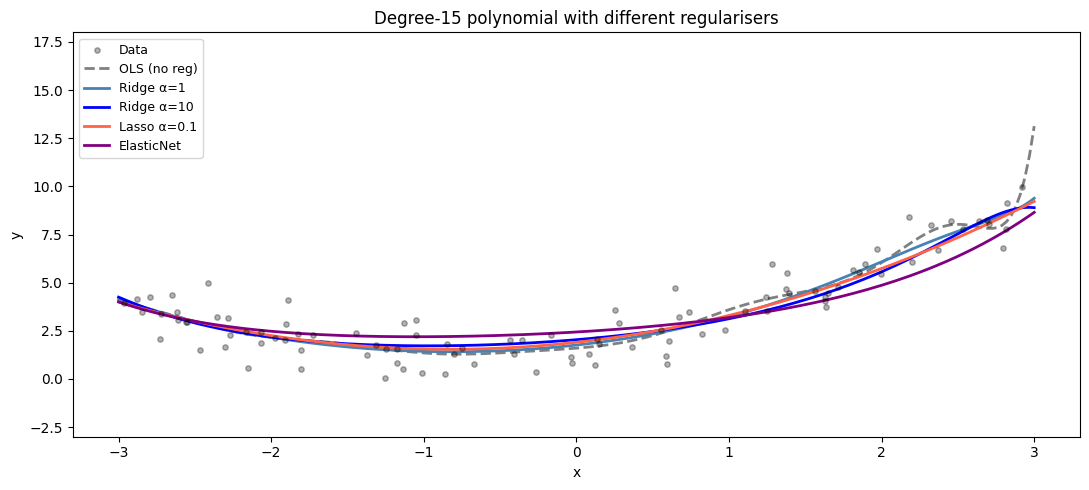
Ridge smooths the polynomial curve, while Lasso may eliminate higher-degree terms, yielding a simpler polynomial.


Choosing the Hyperparameter λ\lambda

The regularization strength λ\lambda is tuned via:

  • Validation Set: Select λ\lambda minimizing error on a validation set.

  • Cross-Validation: Use k-fold cross-validation for limited data.

  • Grid Search: Test λ\lambda values (e.g., 103,102,,10210^{-3}, 10^{-2}, \dots, 10^2) to find the optimum.


Practical Considerations

  • Standardization: Standardize features to zero mean and unit variance, as regularization is sensitive to scale.

  • Elastic Net: Combines L1 and L2 penalties:

    J(θ)=1ni=1n(y(i)θx(i))2+λ1θ1+λ2θ22J(\theta) = \frac{1}{n} \sum_{i=1}^n (y^{(i)} - \theta^\top x^{(i)})^2 + \lambda_1 \|\theta\|_1 + \lambda_2 \|\theta\|_2^2
  • Implementation: Use libraries like scikit-learn for Ridge (Ridge), Lasso (Lasso), and Elastic Net (ElasticNet).


Summary

Regularization enhances linear regression by controlling complexity:

  • Ridge (L2): Shrinks weights, stabilizes solutions, ideal for correlated features.

  • Lasso (L1): Promotes sparsity, selects features, suited for high-dimensional data.

  • Choose L1 or L2 based on whether feature selection or stability is needed.

  • Tune λ\lambda and preprocess features for optimal performance.

import numpy as np
from scipy.linalg import solve
import matplotlib.pyplot as plt

# Generate sample data
np.random.seed(42)
m = 100
X = 6 * np.random.rand(m, 1) - 3
y = 0.5 * X**2 + X + 2 + np.random.randn(m, 1)

# Create data for plotting predictions
X_new = np.linspace(-3, 3, 100).reshape(-1, 1)

# Polynomial features (degree 30)
degree = 30
def create_polynomial_features(X, degree):
    X_poly = np.ones((X.shape[0], 1))
    for d in range(1, degree + 1):
        X_poly = np.hstack((X_poly, X**d))
    return X_poly

X_poly = create_polynomial_features(X, degree)
X_new_poly = create_polynomial_features(X_new, degree)

# Standardize features (excluding bias term)
X_poly_scaled = X_poly.copy()
X_new_poly_scaled = X_new_poly.copy()
mean = np.mean(X_poly[:, 1:], axis=0)
std = np.std(X_poly[:, 1:], axis=0)
X_poly_scaled[:, 1:] = (X_poly[:, 1:] - mean) / std
X_new_poly_scaled[:, 1:] = (X_new_poly[:, 1:] - mean) / std

# Linear Regression (No Regularization) - Normal Equation
def linear_normal_equation(X, y):
    try:
        theta = solve(X.T @ X, X.T @ y, assume_a='pos')
    except np.linalg.LinAlgError:
        # Use pseudo-inverse for ill-conditioned matrices
        theta = np.linalg.pinv(X.T @ X) @ (X.T @ y)
    return theta

# Linear Regression (No Regularization) - Gradient Descent
def linear_gradient_descent(X, y, learning_rate=0.01, n_iterations=1000):
    n_samples, n_features = X.shape
    theta = np.zeros((n_features, 1))
    for _ in range(n_iterations):
        y_pred = X @ theta
        gradient = (1/n_samples) * X.T @ (y_pred - y)
        theta -= learning_rate * gradient
    return theta

# L2 Regularization (Ridge) - Normal Equation
def ridge_normal_equation(X, y, lambda_reg):
    n_features = X.shape[1]
    I = np.eye(n_features)
    I[0, 0] = 0  # Do not regularize bias term
    theta = solve(X.T @ X + lambda_reg * I, X.T @ y, assume_a='pos')
    return theta

# L2 Regularization (Ridge) - Gradient Descent
def ridge_gradient_descent(X, y, lambda_reg, learning_rate=0.01, n_iterations=1000):
    n_samples, n_features = X.shape
    theta = np.zeros((n_features, 1))
    for _ in range(n_iterations):
        y_pred = X @ theta
        gradient = (1/n_samples) * X.T @ (y_pred - y) + lambda_reg * np.vstack([0, theta[1:]])
        theta -= learning_rate * gradient
    return theta

# L1 Regularization (Lasso) - Coordinate Descent
def lasso_coordinate_descent(X, y, lambda_reg, max_iter=1000, tol=1e-4):
    n_samples, n_features = X.shape
    theta = np.zeros((n_features, 1))
    y = y.reshape(-1, 1)
    for _ in range(max_iter):
        theta_old = theta.copy()
        for j in range(n_features):
            if j == 0:  # Bias term
                Xj = X[:, j].reshape(-1, 1)
                y_pred = X @ theta
                rho = (Xj * (y - y_pred + Xj * theta[j])).sum() / n_samples
                theta[j] = rho
            else:  # Regularized terms
                Xj = X[:, j].reshape(-1, 1)
                y_pred = X @ theta
                rho = (Xj * (y - y_pred + Xj * theta[j])).sum() / n_samples
                if rho < -lambda_reg:
                    theta[j] = (rho + lambda_reg) / (Xj.T @ Xj / n_samples)
                elif rho > lambda_reg:
                    theta[j] = (rho - lambda_reg) / (Xj.T @ Xj / n_samples)
                else:
                    theta[j] = 0
        if np.linalg.norm(theta - theta_old) < tol:
            break
    return theta

# Parameters
lambda_reg = 0.1
learning_rate = 0.005  # Adjusted for high-degree polynomial
n_iterations = 2000    # Increased iterations for convergence

# Compute weights
theta_linear_ne = linear_normal_equation(X_poly_scaled, y)
theta_linear_gd = linear_gradient_descent(X_poly_scaled, y, learning_rate, n_iterations)
theta_ridge_ne = ridge_normal_equation(X_poly_scaled, y, lambda_reg)
theta_ridge_gd = ridge_gradient_descent(X_poly_scaled, y, lambda_reg, learning_rate, n_iterations)
theta_lasso_cd = lasso_coordinate_descent(X_poly_scaled, y, lambda_reg)

# Predictions
y_pred_linear_ne = X_new_poly_scaled @ theta_linear_ne
y_pred_linear_gd = X_new_poly_scaled @ theta_linear_gd
y_pred_ridge_ne = X_new_poly_scaled @ theta_ridge_ne
y_pred_ridge_gd = X_new_poly_scaled @ theta_ridge_gd
y_pred_lasso_cd = X_new_poly_scaled @ theta_lasso_cd

# Plot results
plt.figure(figsize=(12, 7))
plt.scatter(X, y, color='black', label='Data', alpha=0.5)
plt.plot(X_new, y_pred_linear_ne, color='orange', label='Linear (Normal Eq)')
plt.plot(X_new, y_pred_linear_gd, color='black', linestyle='--', label='Linear (Gradient Descent)')
plt.plot(X_new, y_pred_ridge_ne, color='blue', label='Ridge (Normal Eq)')
plt.plot(X_new, y_pred_ridge_gd, color='green', linestyle='--', label='Ridge (Gradient Descent)')
plt.plot(X_new, y_pred_lasso_cd, color='red', label='Lasso (Coordinate Descent)')
plt.xlabel('X')
plt.ylabel('y')
plt.title('Polynomial Regression (Degree 30): Linear vs Ridge vs Lasso')
plt.legend()
plt.grid(True)
plt.savefig('poly_regression_degree30_comparison.png')
plt.show()

# Print number of non-zero coefficients for Lasso
non_zero_lasso = np.sum(np.abs(theta_lasso_cd) > 1e-6)
print(f"Lasso: {non_zero_lasso} non-zero coefficients out of {theta_lasso_cd.shape[0]}")
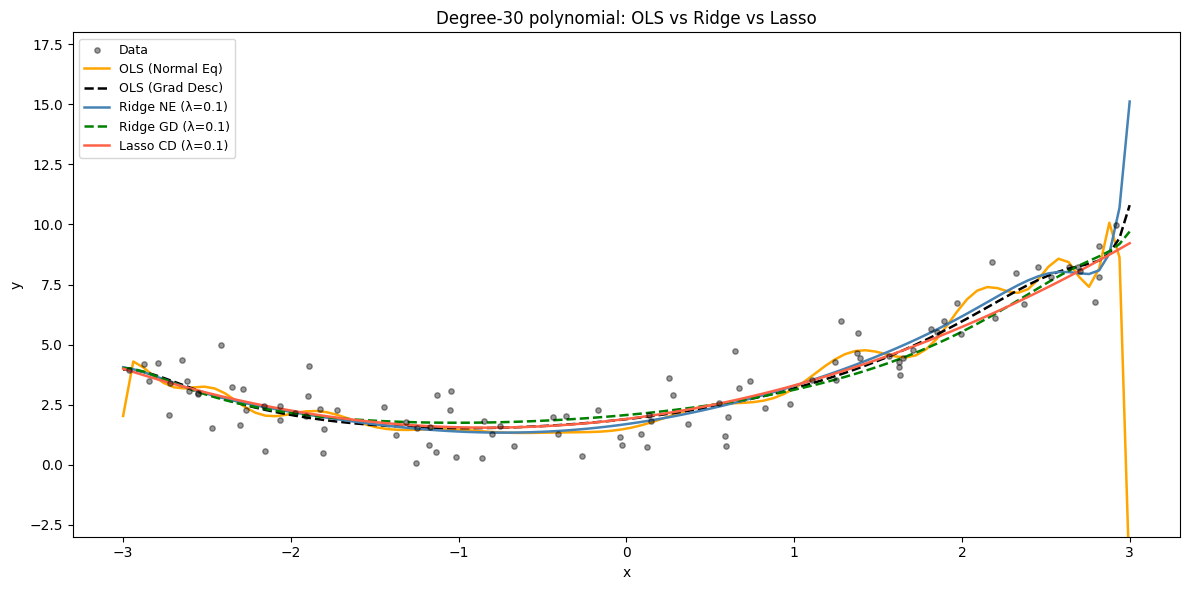
<Figure size 1200x700 with 1 Axes>
Lasso: 3 non-zero coefficients out of 31

Gradient Descent

Concept: Gradient Descent is an iterative optimization algorithm that aims to find the minimum of a function by repeatedly taking steps in the direction of the negative gradient (or an approximation of it). The gradient indicates the direction of the steepest increase of the function at a given point, so moving in the opposite direction should lead towards a minimum.

Algorithm (Simplified):

  1. Initialize the parameter vector θ\theta with some initial values.

  2. Repeat until convergence: a. Calculate the gradient of the cost function J(θ)J(\theta) with respect to θ\theta: θJ(θ)\nabla_{\theta} J(\theta). b. Update the parameter vector in the opposite direction of the gradient:

    θnew=θoldαθJ(θold)\theta_{new} = \theta_{old} - \alpha \nabla_{\theta} J(\theta_{old})

    where α\alpha is the learning rate, a positive scalar that determines the step size.

Types of Gradient Descent:

  • Batch Gradient Descent: Calculates the gradient using the entire training dataset in each iteration. This provides a stable estimate of the gradient but can be computationally expensive for large datasets.

  • Stochastic Gradient Descent (SGD): Calculates the gradient using only one randomly selected data point in each iteration. This is much faster per iteration and can escape local minima more easily due to the noisy updates, but the convergence can be less stable.

  • Mini-Batch Gradient Descent: Calculates the gradient using a small random subset (mini-batch) of the training data in each iteration. This is a compromise between Batch GD and SGD, offering a balance of stability and efficiency.

Advantages of Gradient Descent:

  • General Applicability: Can be applied to a wide range of differentiable functions.

  • Relatively Simple to Implement: The core idea is straightforward.

  • Scalability (especially SGD and Mini-Batch GD): Can handle large datasets more efficiently than Batch GD.

Coordinate Descent

Concept: Coordinate Descent is an optimization algorithm that minimizes a multivariate function by iteratively optimizing along one coordinate direction at a time, while keeping all other coordinates fixed. In each step, the algorithm selects one coordinate (or a block of coordinates) and finds the value that minimizes the objective function along that direction. This process is repeated until convergence.

Algorithm (Simplified - Cyclic Coordinate Descent):

  1. Initialize the parameter vector θ=(θ1,θ2,...,θp)\theta = (\theta_1, \theta_2, ..., \theta_p) with some initial values.

  2. Repeat until convergence: a. For each coordinate jj from 1 to pp: i. Find the value θj\theta_j^* that minimizes the cost function J(θ1,...,θj1,θj,θj+1,...,θp)J(\theta_1, ..., \theta_{j-1}, \theta_j, \theta_{j+1}, ..., \theta_p) with respect to θj\theta_j, while keeping all other θi\theta_i (iji \neq j) fixed at their current values. ii. Update θj=θj\theta_j = \theta_j^*.

Key Differences Summarized

FeatureGradient DescentCoordinate Descent
Update DirectionNegative gradient of all parameters simultaneouslyOne coordinate (or block) at a time
Derivative UsageRequires the gradient of the objective functionMay or may not require derivatives (can be derivative-free)
ImplementationGenerally straightforwardCan be simple, but the single-variable minimization step might require specific solutions
ConvergenceSensitive to learning rate, can get stuck in local minimaCan stall if level curves are misaligned with axes, convergence not always guaranteed
Handling Non-SmoothLess direct, subgradient methods often usedCan handle non-smooth terms more naturally (e.g., L1 norm)
EfficiencyCan be slow per iteration (Batch GD), noisy (SGD)Can be very efficient if 1D minimization is fast
ParallelizationEasier to parallelize gradient computation (especially for mini-batches)Can be challenging to parallelize efficiently due to sequential updates
Example Use CasesNeural networks, general differentiable optimizationLasso and other sparse models, problems with separable or easily minimized single variables

When to Choose Which:

  • Gradient Descent is often the go-to method for large-scale differentiable optimization problems, especially with the advancements in SGD and its variants (like Adam, RMSprop). It’s the workhorse of deep learning.

  • Coordinate Descent can be very effective when dealing with problems where optimizing a single variable (or a small block) is significantly easier than optimizing all variables together. It shines in problems with L1 regularization where the soft-thresholding update has a closed-form solution. It can also be beneficial when the variables are somewhat decoupled.

Coordinate descent with Lasso
  • Remember that LLasso=LSSE+αi=1pθi\mathcal{L}_{Lasso} = \mathcal{L}_{SSE} + \alpha \sum_{i=1}^{p} |\theta_i|

  • For one θi\theta_i: LLasso(θi)=LSSE(θi)+αθi\mathcal{L}_{Lasso}(\theta_i) = \mathcal{L}_{SSE}(\theta_i) + \alpha |\theta_i|

  • The L1 term is not differentiable but convex: we can compute the subgradient

    • Unique at points where L\mathcal{L} is differentiable, a range of all possible slopes [a,b] where it is not

    • For θi|\theta_i|, the subgradient θiθi\partial_{\theta_i} |\theta_i| = {1θi<0[1,1]θi=01θi>0\begin{cases}-1 & \theta_i<0\\ [-1,1] & \theta_i=0 \\ 1 & \theta_i>0 \\ \end{cases}

    • Subdifferential (f+g)=f+g\partial(f+g) = \partial f + \partial g if ff and gg are both convex

  • To find the optimum for Lasso θi\theta_i^{*}, solve

    θiLLasso(θi)=θiLSSE(θi)+θiαθi0=(θiρi)+αθiθiθi=ρiαθiθi\begin{aligned} \partial_{\theta_i} \mathcal{L}_{Lasso}(\theta_i) &= \partial_{\theta_i} \mathcal{L}_{SSE}(\theta_i) + \partial_{\theta_i} \alpha |\theta_i| \\ 0 &= (\theta_i - \rho_i) + \alpha \cdot \partial_{\theta_i} |\theta_i| \\ \theta_i &= \rho_i - \alpha \cdot \partial_{\theta_i} |\theta_i| \end{aligned}
    • In which ρi\rho_i is the part of θiLSSE(θi)\partial_{\theta_i} \mathcal{L}_{SSE}(\theta_i) excluding θi\theta_i (assume zi=1z_i=1 for now)

      • ρi\rho_i can be seen as the LSSE\mathcal{L}_{SSE} ‘solution’: θi=ρi\theta_i = \rho_i if θiLSSE(θi)=0\partial_{\theta_i} \mathcal{L}_{SSE}(\theta_i) = 0

        θiLSSE(θi)=θin=1N(yn(θxn+θ0))2=ziθiρi\partial_{\theta_i} \mathcal{L}_{SSE}(\theta_i) = \partial_{\theta_i} \sum_{n=1}^{N} (y_n-(\mathbf{\theta}\mathbf{x_n} + \theta_0))^2 = z_i \theta_i -\rho_i
  • We found: θi=ρiαθiθi\theta_i = \rho_i - \alpha \cdot \partial_{\theta_i} |\theta_i|

  • The Lasso solution has the form of a soft thresholding function SS

    θi=S(ρi,α)={ρi+α,ρi<α0,α<ρi<αρiα,ρi>α\theta_i^* = S(\rho_i,\alpha) = \begin{cases} \rho_i + \alpha, & \rho_i < -\alpha \\ 0, & -\alpha < \rho_i < \alpha \\ \rho_i - \alpha, & \rho_i > \alpha \\ \end{cases}
    • Small weights (all weights between α-\alpha and α\alpha) become 0: sparseness!

    • If the data is not normalized, θi=1ziS(ρi,α)\theta_i^* = \frac{1}{z_i}S(\rho_i,\alpha) with constant zi=n=1Nxni2z_i = \sum_{n=1}^{N} x_{ni}^2

  • Ridge solution: θi=ρiαθiθi2=ρi2αθi\theta_i = \rho_i - \alpha \cdot \partial_{\theta_i} \theta_i^2 = \rho_i - 2\alpha \cdot \theta_i, thus θi=ρi1+2α\theta_i^* = \frac{\rho_i}{1 + 2\alpha}

Sparsity: Definition

A vector is said to be sparse if a large fraction of its entries is zero.

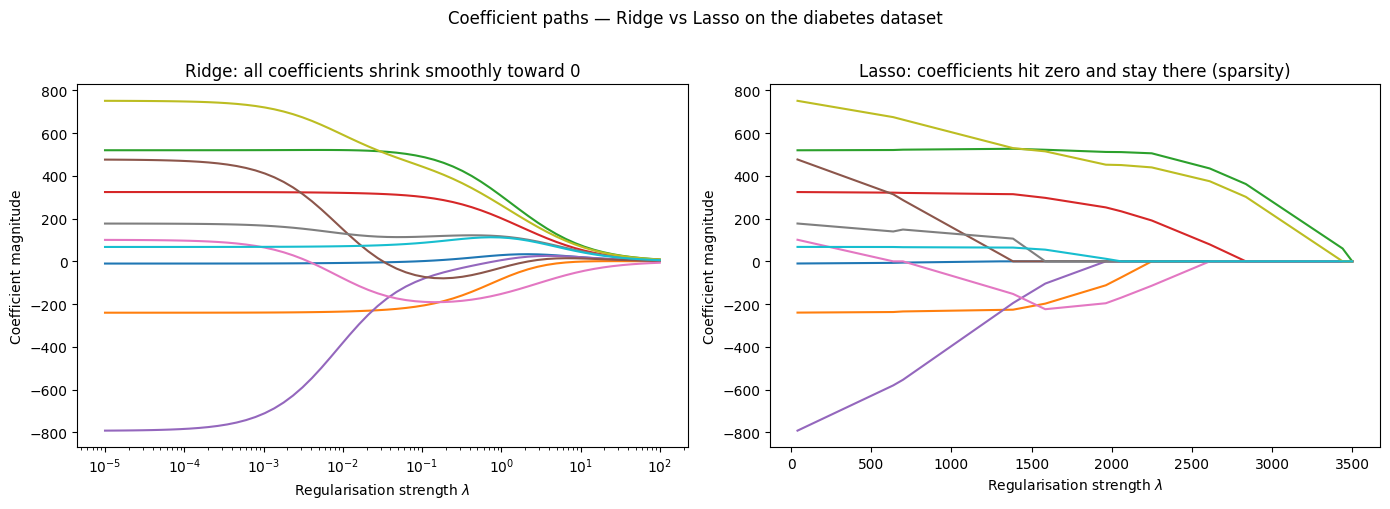
To better understand sparsity, we fit Ridge and Lasso on the UCI diabetes dataset and observe the magnitude of each weight (colored lines) as a function of the regularization parameter.

The Lasso parameters become progressively smaller, until they reach exactly zero, and then they stay at zero.

Below, we are going to visualize the parameters θ\theta^* of Ridge and Lasso as a function of λ\lambda.

# Based on: https://scikit-learn.org/stable/auto_examples/linear_model/plot_lasso_lars.html
import warnings
warnings.filterwarnings("ignore")
from sklearn.datasets import load_diabetes
from sklearn.linear_model import lars_path

from sklearn.linear_model import Ridge
from matplotlib import pyplot as plt

X, y = load_diabetes(return_X_y=True)

# create ridge coefficients
alphas = np.logspace(-5, 2,  )
ridge_coefs = []
for a in alphas:
    ridge = Ridge(alpha=a, fit_intercept=False)
    ridge.fit(X, y)
    ridge_coefs.append(ridge.coef_)

# create lasso coefficients
X, y = load_diabetes(return_X_y=True)
_, _, lasso_coefs = lars_path(X, y, method='lasso')
xx = np.sum(np.abs(lasso_coefs.T), axis=1)

# plot ridge coefficients
plt.figure(figsize=(14, 5))
plt.subplot(1, 2, 1)
plt.plot(alphas, ridge_coefs)
plt.xscale('log')
plt.xlabel('Regularization Strength (lambda)')
plt.ylabel('Magnitude of model parameters')
plt.title('Ridge coefficients as a function of regularization strength $\lambda$')
plt.axis('tight')

# plot lasso coefficients
plt.subplot(1, 2, 2)
plt.plot(3500-xx, lasso_coefs.T)
ymin, ymax = plt.ylim()
plt.ylabel('Magnitude of model parameters')
plt.xlabel('Regularization Strength (lambda)')
plt.title('LASSO coefficients as a function of regularization strength $\lambda$')
plt.axis('tight')
(-132.97651405942682, 3672.9988816218774, -869.3481054580469, 828.4461664627397)
<Figure size 1400x500 with 2 Axes>
  • As λ increases, Ridge shrinks all coefficients smoothly toward zero.

  • As Lasso regularization increases (moving left on the x-axis), more coefficients go to exactly zero.

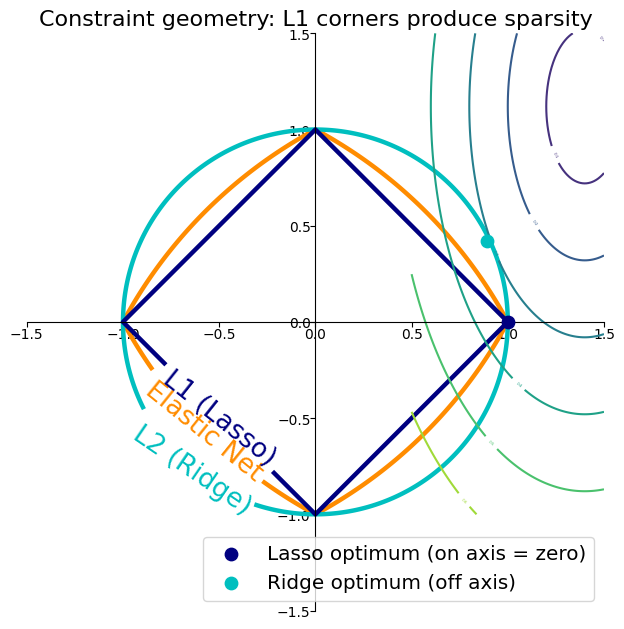
  • In 2D (for 2 model weights θ1\theta_1 and θ2\theta_2)

    • The least squared loss is a 2D convex function in this space (ellipses on the right)

    • For illustration, assume that L1 loss = L2 loss = 1

      • L1 loss (Σθi\Sigma |\theta_i|): the optimal {θ1,θ2\theta_1, \theta_2} (blue dot) falls on the diamond

      • L2 loss (Σθi2\Sigma \theta_i^2): the optimal {θ1,θ2\theta_1, \theta_2} (cyan dot) falls on the circle

    • For L1, the loss is minimized if θ1\theta_1 or θ2\theta_2 is 0 (rarely so for L2)

Elastic-Net

  • Adds both L1 and L2 regularization:

LElastic=n=1N(yn(θxn+θ0))2+αρi=1pθi+α(1ρ)i=1pθi2\mathcal{L}_{Elastic} = \sum_{n=1}^{N} (y_n-(\mathbf{\theta}\mathbf{x_n} + \theta_0))^2 + \alpha \rho \sum_{i=1}^{p} |\theta_i| + \alpha (1 - \rho) \sum_{i=1}^{p} \theta_i^2
  • ρ\rho is the L1 ratio

    • With ρ=1\rho=1, LElastic=LLasso\mathcal{L}_{Elastic} = \mathcal{L}_{Lasso}

    • With ρ=0\rho=0, LElastic=LRidge\mathcal{L}_{Elastic} = \mathcal{L}_{Ridge}

    • 0<ρ<10 < \rho < 1 sets a trade-off between L1 and L2.

  • Allows learning sparse models (like Lasso) while maintaining L2 regularization benefits

    • E.g. if 2 features are correlated, Lasso likely picks one randomly, Elastic-Net keeps both

  • Weights can be optimized using coordinate descent (similar to Lasso)

fig_scale = 2

def plot_loss_interpretation():
    line = np.linspace(-1.5, 1.5, 1001)
    xx, yy = np.meshgrid(line, line)

    l2 = xx ** 2 + yy ** 2
    l1 = np.abs(xx) + np.abs(yy)
    rho = 0.7
    elastic_net = rho * l1 + (1 - rho) * l2

    plt.figure(figsize=(5*fig_scale, 4*fig_scale))
    ax = plt.gca()

    elastic_net_contour = plt.contour(xx, yy, elastic_net, levels=[1], linewidths=2*fig_scale, colors="darkorange")
    l2_contour = plt.contour(xx, yy, l2, levels=[1], linewidths=2*fig_scale, colors="c")
    l1_contour = plt.contour(xx, yy, l1, levels=[1], linewidths=2*fig_scale, colors="navy")
    ax.set_aspect("equal")
    ax.spines['left'].set_position('center')
    ax.spines['right'].set_color('none')
    ax.spines['bottom'].set_position('center')
    ax.spines['top'].set_color('none')

    plt.clabel(elastic_net_contour, inline=1, fontsize=12*fig_scale,
               fmt={1.0: 'elastic-net'}, manual=[(-0.6, -0.6)])
    plt.clabel(l2_contour, inline=1, fontsize=12*fig_scale,
               fmt={1.0: 'L2'}, manual=[(-0.5, -0.5)])
    plt.clabel(l1_contour, inline=1, fontsize=12*fig_scale,
               fmt={1.0: 'L1'}, manual=[(-0.5, -0.5)])

    x1 = np.linspace(0.5, 1.5, 100)
    x2 = np.linspace(-1.0, 1.5, 100)
    X1, X2 = np.meshgrid(x1, x2)
    Y = np.sqrt(np.square(X1/2-0.7) + np.square(X2/4-0.28))
    cp = plt.contour(X1, X2, Y)
    plt.clabel(cp, inline=1, fontsize=3)
    ax.tick_params(axis='both', pad=0)
    ax.scatter(1, 0, c="navy", s=50*fig_scale)
    ax.scatter(0.89, 0.42, c="c", s=50*fig_scale)

    plt.tight_layout()
    plt.show()
plot_loss_interpretation()
<Figure size 1000x800 with 1 Axes>

Imagine you’re trying to find the lowest point in a valley (this is like minimizing the loss function).

  • No Regularization: You are free to roam anywhere in the valley to find the absolute lowest point.

  • L2 Regularization (the circle): Now, imagine there’s a rule that says the total “distance squared” you can move from your starting point (which we can consider the origin in the parameter space) is limited. This limit is represented by the inside of the circle. You still want to get to the lowest point in the valley, but you can’t go beyond the boundary of the circle. The optimal point you reach will be the lowest point within or on the boundary of the circle. It’s a compromise between minimizing the loss and staying “close” to the origin in terms of the L2 norm.

  • L1 Regularization (the diamond): Now, the rule is different. The total “Manhattan distance” you can move from your starting point is limited, represented by the inside of the diamond. Again, you want to find the lowest point in the valley, but you’re restricted to the diamond shape. The lowest point you can reach within or on the boundary of the diamond might be at one of its corners, which corresponds to some of your model parameters becoming exactly zero.

  • Elastic Net (the blended shape): This is like having a combined rule, a mix of the “distance squared” and the “Manhattan distance” being limited. The allowed region is the area inside the blended shape.

Key takeaway:

  • The loss function (represented by the color-filled contours in the plot) is what we are trying to minimize. The goal of training is to find the parameter values that result in the lowest possible value of this loss function.

  • Regularization (L1, L2, Elastic Net) adds a penalty to the loss function based on the magnitude of the model’s parameters. This penalty creates a constraint on the parameter values. We want to minimize the total objective, which includes both the original loss and the regularization penalty.

  • The contours of L1, L2, and Elastic Net (the diamond, circle, and blended shape) visualize the boundary of this regularization constraint for a fixed penalty strength (in this plot, the level is set to 1 for illustration). The optimal parameter values are often found where the loss function’s contours meet or are tangent to these constraint boundaries.

Regularizing via Constraints

Consider a regularized problem with a penalty term:

minθΘL(θ)+λR(θ).\min_{\theta \in \Theta} L(\theta) + \lambda \cdot R(\theta).

Alternatively, we may enforce an explicit constraint on the complexity of the model:

minθΘ  L(θ)such that   R(θ)λ\begin{align*} \min_{\theta \in \Theta} \; & L(\theta) \\ \text{such that } \; & R(\theta) \leq \lambda' \end{align*}

Cross-Validation & Model Selection

•	Use k-fold cross-validation to estimate model performance.
•	Split data into training and validation sets multiple times.

🧪 Understanding Cross-Validation with Ridge and Lasso

We want to evaluate how well our model generalizes to unseen data. A common method is kk-fold cross-validation:

  • Split the dataset into kk parts (folds).

  • Train the model on k1k-1 folds and test on the remaining one.

  • Repeat this process kk times, each time using a different fold as the test set.

  • Compute the average validation score.

This gives a reliable estimate of model performance.

💡 Regularization and Cross-Validation

We test multiple values of the regularization parameter alpha\\alpha for both Ridge and Lasso regressions:

  • Ridge regression minimizes:

    minθXθy22+αθ22\min_{\theta} \|X\theta - y\|^2_2 + \alpha \|\theta\|^2_2
  • Lasso regression minimizes:

    minθXθy22+αθ1\min_{\theta} \|X\theta - y\|^2_2 + \alpha \|\theta\|_1

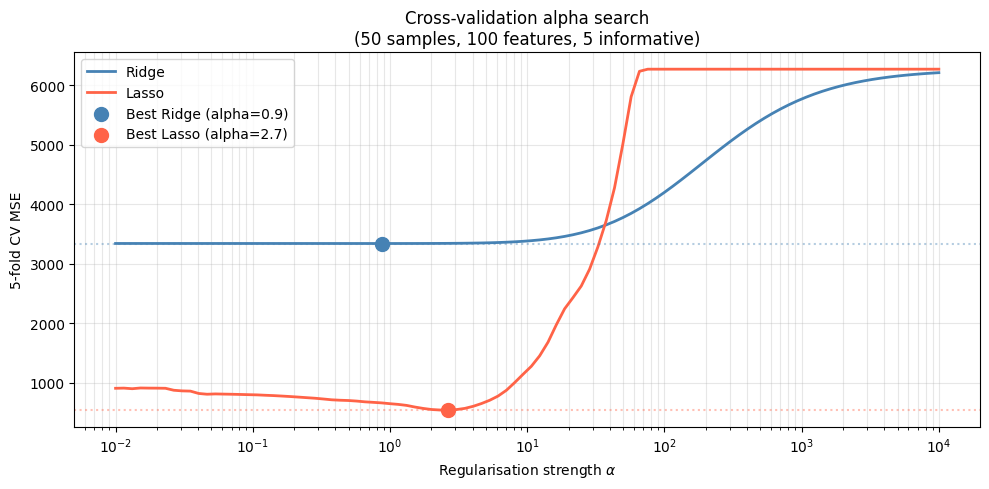
We use 5-fold cross-validation to compute average scores for each alpha\\alpha, and plot them.

📈 Plot Meaning

  • X-axis: alpha\\alpha values (log-scaled).

  • Y-axis: Cross-validation score (higher is better).

  • We compare Ridge and Lasso to see which performs better on the dataset.

The best alpha\\alpha is the one that maximizes the cross-validation score.

import numpy as np
import matplotlib.pyplot as plt
from sklearn.linear_model import Ridge, Lasso
from sklearn.datasets import make_regression
from sklearn.model_selection import cross_val_score
from sklearn.preprocessing import StandardScaler

# Generate challenging data - corrected version
X, y = make_regression(n_samples=50, n_features=100, 
                      n_informative=5, noise=20,
                      random_state=42)

# Standardize features
scaler = StandardScaler()
X_scaled = scaler.fit_transform(X)

# Define alpha values
alphas = np.logspace(-2, 4, 100)

# Store MSE values
ridge_mse = []
lasso_mse = []

for alpha in alphas:
    # Ridge regression
    ridge = Ridge(alpha=alpha, max_iter=10000)
    ridge_mse.append(np.mean(-cross_val_score(ridge, X_scaled, y, cv=5, 
                       scoring='neg_mean_squared_error')))
    
    # Lasso regression
    lasso = Lasso(alpha=alpha, max_iter=10000)
    lasso_mse.append(np.mean(-cross_val_score(lasso, X_scaled, y, cv=5, 
                       scoring='neg_mean_squared_error')))

# Find optimal alphas
optimal_ridge = alphas[np.argmin(ridge_mse)]
optimal_lasso = alphas[np.argmin(lasso_mse)]

# Plotting
plt.figure(figsize=(12, 7))
plt.semilogx(alphas, ridge_mse, label='Ridge', color='blue', linewidth=2)
plt.semilogx(alphas, lasso_mse, label='Lasso', color='red', linewidth=2)

# Highlight minima
plt.scatter(optimal_ridge, min(ridge_mse), color='blue', s=100, 
           label=f'Best Ridge (α={optimal_ridge:.1f})')
plt.scatter(optimal_lasso, min(lasso_mse), color='red', s=100,
           label=f'Best Lasso (α={optimal_lasso:.1f})')

# Add reference lines
plt.axhline(min(ridge_mse), color='blue', linestyle=':', alpha=0.3)
plt.axhline(min(lasso_mse), color='red', linestyle=':', alpha=0.3)

plt.title('Regularization Benefits in High-Dimensional Data\n(50 samples, 100 features, 5 informative)')
plt.xlabel('Regularization strength (α)')
plt.ylabel('Mean Squared Error (MSE)')
plt.legend()
plt.grid(True, which='both', alpha=0.4)
plt.show()

# Print comparison
print(f"OLS (α≈0) MSE: {ridge_mse[0]:.1f}")
print(f"Optimal Ridge MSE: {min(ridge_mse):.1f} (Improvement: {100*(ridge_mse[0]-min(ridge_mse))/ridge_mse[0]:.1f}%)")
print(f"Optimal Lasso MSE: {min(lasso_mse):.1f} (Improvement: {100*(lasso_mse[0]-min(lasso_mse))/lasso_mse[0]:.1f}%)")
<Figure size 1200x700 with 1 Axes>
OLS (α≈0) MSE: 3338.7
Optimal Ridge MSE: 3338.2 (Improvement: 0.0%)
Optimal Lasso MSE: 539.3 (Improvement: 40.4%)
# Your code here