Bias–Variance Tradeoff
The Fundamental Tension in Every Model
Every model makes a choice: be simple and predictable, or be flexible and expressive. Push too far in either direction and generalisation suffers. This notebook gives you the mathematical decomposition of error, the tools to diagnose which problem you have, and the practical levers to fix it.
Intuition — The Bullseye Analogy
Imagine shooting arrows at a target:
| Pattern | Bias | Variance | Meaning |
|---|---|---|---|
| All arrows clustered, but off-centre | High | Low | Consistently wrong — underfitting |
| Arrows scattered everywhere | Low | High | Unpredictable — overfitting |
| All arrows near centre | Low | Low | The goal |
| Arrows scattered AND off-centre | High | High | Worst case |
Bias = systematic error — the model consistently misses in the same direction because it is too simple to capture the true pattern.
Variance = instability — the model’s predictions shift a lot depending on which training samples it saw.
Irreducible error = the noise floor in the data itself; no model can eliminate it.
Mathematical Decomposition
For a regression problem with true function and noise :
The expected test MSE at a point , averaged over all possible training sets , decomposes as:
| Term | Formula | Meaning |
|---|---|---|
| How far the average prediction is from truth | ||
| How much predictions scatter across training sets | ||
| Irreducible noise — cannot be reduced |
The U-Shaped Error Curve
As model complexity increases:
decreases (the model can represent more patterns)
increases (the model becomes more sensitive to its specific training data)
Total error = forms a U-shape — there is an optimal complexity in the middle.
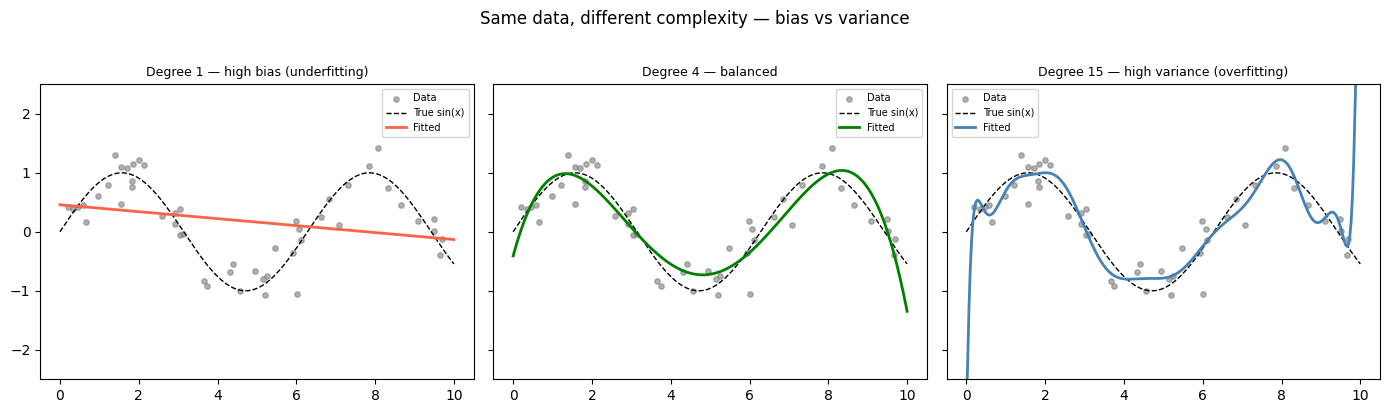
Visualising the Tradeoff — Model Fits at Different Complexities
%matplotlib inline
import numpy as np
import matplotlib.pyplot as plt
from sklearn.preprocessing import PolynomialFeatures, StandardScaler
from sklearn.linear_model import LinearRegression
from sklearn.pipeline import make_pipeline

np.random.seed(42)
n = 50
X_all = np.sort(np.random.rand(n) * 10).reshape(-1, 1)
y_all = np.sin(X_all).ravel() + np.random.randn(n) * 0.3

X_plot = np.linspace(0, 10, 300).reshape(-1, 1)
y_true = np.sin(X_plot).ravel()

degrees = [1, 4, 15]
labels  = ['Degree 1 — high bias (underfitting)',
           'Degree 4 — balanced',
           'Degree 15 — high variance (overfitting)']
colors  = ['tomato', 'green', 'steelblue']

fig, axes = plt.subplots(1, 3, figsize=(14, 4), sharey=True)
for ax, degree, label, color in zip(axes, degrees, labels, colors):
    pipe = make_pipeline(PolynomialFeatures(degree), StandardScaler(), LinearRegression())
    pipe.fit(X_all, y_all)
    ax.scatter(X_all, y_all, color='grey', s=15, alpha=0.6, label='Data')
    ax.plot(X_plot, y_true, 'k--', linewidth=1, label='True sin(x)')
    ax.plot(X_plot, np.clip(pipe.predict(X_plot), -3, 3), color=color, linewidth=2, label='Fitted')
    ax.set_title(label, fontsize=9)
    ax.set_ylim(-2.5, 2.5)
    ax.legend(fontsize=7)

plt.suptitle('Same data, different complexity — bias vs variance', y=1.02)
plt.tight_layout()
plt.show()
/Volumes/MacSSD/01_Projects/Chandravesh-ML-Research/projects/jupyter-books/.venv/lib/python3.10/site-packages/sklearn/linear_model/_base.py:280: RuntimeWarning: divide by zero encountered in matmul
return X @ coef_ + self.intercept_
/Volumes/MacSSD/01_Projects/Chandravesh-ML-Research/projects/jupyter-books/.venv/lib/python3.10/site-packages/sklearn/linear_model/_base.py:280: RuntimeWarning: overflow encountered in matmul
return X @ coef_ + self.intercept_
/Volumes/MacSSD/01_Projects/Chandravesh-ML-Research/projects/jupyter-books/.venv/lib/python3.10/site-packages/sklearn/linear_model/_base.py:280: RuntimeWarning: invalid value encountered in matmul
return X @ coef_ + self.intercept_
/Volumes/MacSSD/01_Projects/Chandravesh-ML-Research/projects/jupyter-books/.venv/lib/python3.10/site-packages/sklearn/linear_model/_base.py:280: RuntimeWarning: divide by zero encountered in matmul
return X @ coef_ + self.intercept_
/Volumes/MacSSD/01_Projects/Chandravesh-ML-Research/projects/jupyter-books/.venv/lib/python3.10/site-packages/sklearn/linear_model/_base.py:280: RuntimeWarning: overflow encountered in matmul
return X @ coef_ + self.intercept_
/Volumes/MacSSD/01_Projects/Chandravesh-ML-Research/projects/jupyter-books/.venv/lib/python3.10/site-packages/sklearn/linear_model/_base.py:280: RuntimeWarning: invalid value encountered in matmul
return X @ coef_ + self.intercept_
Empirical Decomposition — Bootstrapping Bias and Variance
We can estimate bias and variance empirically by training the model on many bootstrap samples and observing how predictions scatter.
%matplotlib inline
import numpy as np
import matplotlib.pyplot as plt
from sklearn.preprocessing import PolynomialFeatures, StandardScaler
from sklearn.linear_model import LinearRegression
from sklearn.pipeline import make_pipeline
def true_func(x):
return np.sin(x)
rng = np.random.default_rng(7)
n_train = 40
n_boot = 80
X_train = np.sort(rng.uniform(0, 10, n_train)).reshape(-1, 1)
X_eval = np.linspace(0, 10, 200).reshape(-1, 1)
y_true_eval = true_func(X_eval.ravel())
degrees = [1, 3, 5, 10, 20]
bias2_list, var_list, total_list = [], [], []
for degree in degrees:
preds_boot = np.zeros((n_boot, len(X_eval)))
for b in range(n_boot):
idx = rng.integers(0, n_train, n_train)
Xb = X_train[idx]
yb = true_func(Xb.ravel()) + rng.normal(0, 0.3, n_train)
pipe = make_pipeline(PolynomialFeatures(degree), StandardScaler(), LinearRegression())
pipe.fit(Xb, yb)
preds_boot[b] = pipe.predict(X_eval)
mean_pred = preds_boot.mean(axis=0)
b2 = np.mean((mean_pred - y_true_eval) ** 2)
v = np.mean(preds_boot.var(axis=0))
bias2_list.append(b2)
var_list.append(v)
total_list.append(b2 + v + 0.09) # 0.09 = sigma^2 = 0.3^2
fig, ax = plt.subplots(figsize=(9, 5))
ax.plot(degrees, bias2_list, 'b-o', linewidth=2, label=r'Bias$^2$')
ax.plot(degrees, var_list, 'r-o', linewidth=2, label='Variance')
ax.plot(degrees, total_list, 'g-o', linewidth=2, label=r'Bias$^2$ + Var + $\sigma^2$')
ax.set_xlabel('Polynomial degree')
ax.set_ylabel('Error component')
ax.set_title('Empirical bias-variance decomposition via bootstrapping')
ax.legend()
ax.grid(True, alpha=0.3)
plt.tight_layout()
plt.show()
print(f"{'Degree':>6} {'Bias2':>8} {'Variance':>10} {'Total':>8}")
for d, b2, v, t in zip(degrees, bias2_list, var_list, total_list):
print(f"{d:>6} {b2:>8.4f} {v:>10.4f} {t:>8.4f}")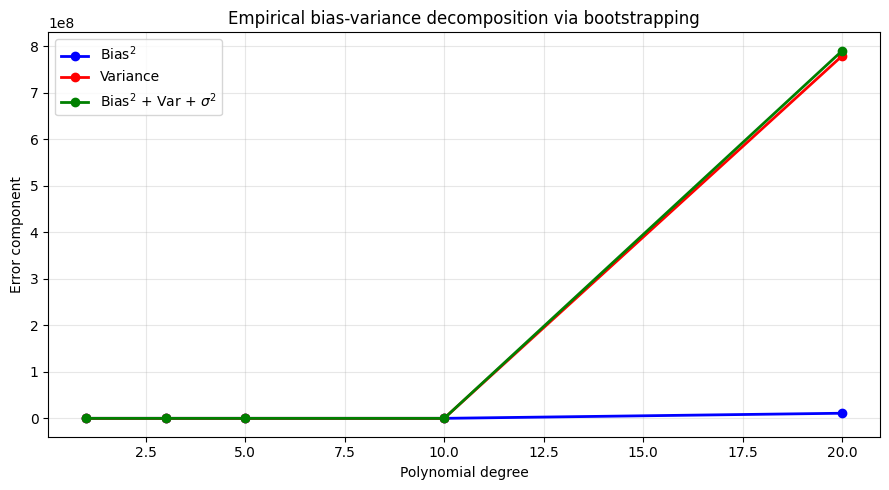
Degree Bias2 Variance Total
1 0.4410 0.0218 0.5528
3 0.3814 0.1225 0.5939
5 0.0373 0.0416 0.1689
10 0.1265 10.7161 10.9327
20 10976269.8496 779420743.7784 790397013.7179
Learning Curves — Diagnosing Bias vs Variance
A learning curve plots train and validation error against training set size. The pattern reveals which problem dominates.
%matplotlib inline
import numpy as np
import matplotlib.pyplot as plt
from sklearn.preprocessing import PolynomialFeatures, StandardScaler
from sklearn.linear_model import LinearRegression
from sklearn.pipeline import make_pipeline
from sklearn.model_selection import learning_curve
np.random.seed(0)
n = 100
X = np.sort(np.random.rand(n) * 10).reshape(-1, 1)
y = np.sin(X).ravel() + np.random.randn(n) * 0.5
def plot_lc(degree, ax, title):
pipe = make_pipeline(PolynomialFeatures(degree), StandardScaler(), LinearRegression())
sizes, tr_sc, val_sc = learning_curve(
pipe, X, y, cv=5,
scoring='neg_mean_squared_error',
train_sizes=np.linspace(0.1, 1.0, 8)
)
tr_mse = -tr_sc.mean(axis=1)
val_mse = -val_sc.mean(axis=1)
ax.plot(sizes, tr_mse, 'b-o', linewidth=2, markersize=5, label='Training MSE')
ax.plot(sizes, val_mse, 'r-o', linewidth=2, markersize=5, label='Validation MSE')
ax.set_title(title, fontsize=10)
ax.set_xlabel('Training set size')
ax.set_ylabel('MSE')
ax.legend(fontsize=8)
ax.grid(True, alpha=0.3)
return tr_mse[-1], val_mse[-1]
fig, axes = plt.subplots(1, 2, figsize=(12, 5))
tr1, v1 = plot_lc(1, axes[0], 'Degree 1 — High Bias (Underfitting)')
tr15, v15 = plot_lc(15, axes[1], 'Degree 15 — High Variance (Overfitting)')
plt.suptitle('Learning curves reveal the dominant problem', y=1.02)
plt.tight_layout()
plt.show()
print(f'Degree 1: train MSE={tr1:.3f} val MSE={v1:.3f} gap={v1-tr1:.3f}')
print(f'Degree 15: train MSE={tr15:.3f} val MSE={v15:.3f} gap={v15-tr15:.3f}')/Volumes/MacSSD/01_Projects/Chandravesh-ML-Research/projects/jupyter-books/.venv/lib/python3.10/site-packages/sklearn/linear_model/_base.py:280: RuntimeWarning: divide by zero encountered in matmul
return X @ coef_ + self.intercept_
/Volumes/MacSSD/01_Projects/Chandravesh-ML-Research/projects/jupyter-books/.venv/lib/python3.10/site-packages/sklearn/linear_model/_base.py:280: RuntimeWarning: overflow encountered in matmul
return X @ coef_ + self.intercept_
/Volumes/MacSSD/01_Projects/Chandravesh-ML-Research/projects/jupyter-books/.venv/lib/python3.10/site-packages/sklearn/linear_model/_base.py:280: RuntimeWarning: invalid value encountered in matmul
return X @ coef_ + self.intercept_
/Volumes/MacSSD/01_Projects/Chandravesh-ML-Research/projects/jupyter-books/.venv/lib/python3.10/site-packages/sklearn/linear_model/_base.py:280: RuntimeWarning: divide by zero encountered in matmul
  return X @ coef_ + self.intercept_
/Volumes/MacSSD/01_Projects/Chandravesh-ML-Research/projects/jupyter-books/.venv/lib/python3.10/site-packages/sklearn/linear_model/_base.py:280: RuntimeWarning: overflow encountered in matmul
  return X @ coef_ + self.intercept_
/Volumes/MacSSD/01_Projects/Chandravesh-ML-Research/projects/jupyter-books/.venv/lib/python3.10/site-packages/sklearn/linear_model/_base.py:280: RuntimeWarning: invalid value encountered in matmul
  return X @ coef_ + self.intercept_
/Volumes/MacSSD/01_Projects/Chandravesh-ML-Research/projects/jupyter-books/.venv/lib/python3.10/site-packages/sklearn/linear_model/_base.py:280: RuntimeWarning: divide by zero encountered in matmul
  return X @ coef_ + self.intercept_
/Volumes/MacSSD/01_Projects/Chandravesh-ML-Research/projects/jupyter-books/.venv/lib/python3.10/site-packages/sklearn/linear_model/_base.py:280: RuntimeWarning: overflow encountered in matmul
  return X @ coef_ + self.intercept_
/Volumes/MacSSD/01_Projects/Chandravesh-ML-Research/projects/jupyter-books/.venv/lib/python3.10/site-packages/sklearn/linear_model/_base.py:280: RuntimeWarning: invalid value encountered in matmul
  return X @ coef_ + self.intercept_
/Volumes/MacSSD/01_Projects/Chandravesh-ML-Research/projects/jupyter-books/.venv/lib/python3.10/site-packages/sklearn/linear_model/_base.py:280: RuntimeWarning: divide by zero encountered in matmul
  return X @ coef_ + self.intercept_
/Volumes/MacSSD/01_Projects/Chandravesh-ML-Research/projects/jupyter-books/.venv/lib/python3.10/site-packages/sklearn/linear_model/_base.py:280: RuntimeWarning: overflow encountered in matmul
  return X @ coef_ + self.intercept_
/Volumes/MacSSD/01_Projects/Chandravesh-ML-Research/projects/jupyter-books/.venv/lib/python3.10/site-packages/sklearn/linear_model/_base.py:280: RuntimeWarning: invalid value encountered in matmul
  return X @ coef_ + self.intercept_
/Volumes/MacSSD/01_Projects/Chandravesh-ML-Research/projects/jupyter-books/.venv/lib/python3.10/site-packages/sklearn/linear_model/_base.py:280: RuntimeWarning: divide by zero encountered in matmul
  return X @ coef_ + self.intercept_
/Volumes/MacSSD/01_Projects/Chandravesh-ML-Research/projects/jupyter-books/.venv/lib/python3.10/site-packages/sklearn/linear_model/_base.py:280: RuntimeWarning: overflow encountered in matmul
  return X @ coef_ + self.intercept_
/Volumes/MacSSD/01_Projects/Chandravesh-ML-Research/projects/jupyter-books/.venv/lib/python3.10/site-packages/sklearn/linear_model/_base.py:280: RuntimeWarning: invalid value encountered in matmul
  return X @ coef_ + self.intercept_
/Volumes/MacSSD/01_Projects/Chandravesh-ML-Research/projects/jupyter-books/.venv/lib/python3.10/site-packages/sklearn/linear_model/_base.py:280: RuntimeWarning: divide by zero encountered in matmul
  return X @ coef_ + self.intercept_
/Volumes/MacSSD/01_Projects/Chandravesh-ML-Research/projects/jupyter-books/.venv/lib/python3.10/site-packages/sklearn/linear_model/_base.py:280: RuntimeWarning: overflow encountered in matmul
  return X @ coef_ + self.intercept_
/Volumes/MacSSD/01_Projects/Chandravesh-ML-Research/projects/jupyter-books/.venv/lib/python3.10/site-packages/sklearn/linear_model/_base.py:280: RuntimeWarning: invalid value encountered in matmul
  return X @ coef_ + self.intercept_
/Volumes/MacSSD/01_Projects/Chandravesh-ML-Research/projects/jupyter-books/.venv/lib/python3.10/site-packages/sklearn/linear_model/_base.py:280: RuntimeWarning: divide by zero encountered in matmul
  return X @ coef_ + self.intercept_
/Volumes/MacSSD/01_Projects/Chandravesh-ML-Research/projects/jupyter-books/.venv/lib/python3.10/site-packages/sklearn/linear_model/_base.py:280: RuntimeWarning: overflow encountered in matmul
  return X @ coef_ + self.intercept_
/Volumes/MacSSD/01_Projects/Chandravesh-ML-Research/projects/jupyter-books/.venv/lib/python3.10/site-packages/sklearn/linear_model/_base.py:280: RuntimeWarning: invalid value encountered in matmul
  return X @ coef_ + self.intercept_
/Volumes/MacSSD/01_Projects/Chandravesh-ML-Research/projects/jupyter-books/.venv/lib/python3.10/site-packages/sklearn/linear_model/_base.py:280: RuntimeWarning: divide by zero encountered in matmul
  return X @ coef_ + self.intercept_
/Volumes/MacSSD/01_Projects/Chandravesh-ML-Research/projects/jupyter-books/.venv/lib/python3.10/site-packages/sklearn/linear_model/_base.py:280: RuntimeWarning: overflow encountered in matmul
  return X @ coef_ + self.intercept_
/Volumes/MacSSD/01_Projects/Chandravesh-ML-Research/projects/jupyter-books/.venv/lib/python3.10/site-packages/sklearn/linear_model/_base.py:280: RuntimeWarning: invalid value encountered in matmul
  return X @ coef_ + self.intercept_
/Volumes/MacSSD/01_Projects/Chandravesh-ML-Research/projects/jupyter-books/.venv/lib/python3.10/site-packages/sklearn/linear_model/_base.py:280: RuntimeWarning: divide by zero encountered in matmul
return X @ coef_ + self.intercept_
/Volumes/MacSSD/01_Projects/Chandravesh-ML-Research/projects/jupyter-books/.venv/lib/python3.10/site-packages/sklearn/linear_model/_base.py:280: RuntimeWarning: overflow encountered in matmul
return X @ coef_ + self.intercept_
/Volumes/MacSSD/01_Projects/Chandravesh-ML-Research/projects/jupyter-books/.venv/lib/python3.10/site-packages/sklearn/linear_model/_base.py:280: RuntimeWarning: invalid value encountered in matmul
return X @ coef_ + self.intercept_
/Volumes/MacSSD/01_Projects/Chandravesh-ML-Research/projects/jupyter-books/.venv/lib/python3.10/site-packages/sklearn/linear_model/_base.py:280: RuntimeWarning: divide by zero encountered in matmul
return X @ coef_ + self.intercept_
/Volumes/MacSSD/01_Projects/Chandravesh-ML-Research/projects/jupyter-books/.venv/lib/python3.10/site-packages/sklearn/linear_model/_base.py:280: RuntimeWarning: overflow encountered in matmul
return X @ coef_ + self.intercept_
/Volumes/MacSSD/01_Projects/Chandravesh-ML-Research/projects/jupyter-books/.venv/lib/python3.10/site-packages/sklearn/linear_model/_base.py:280: RuntimeWarning: invalid value encountered in matmul
return X @ coef_ + self.intercept_
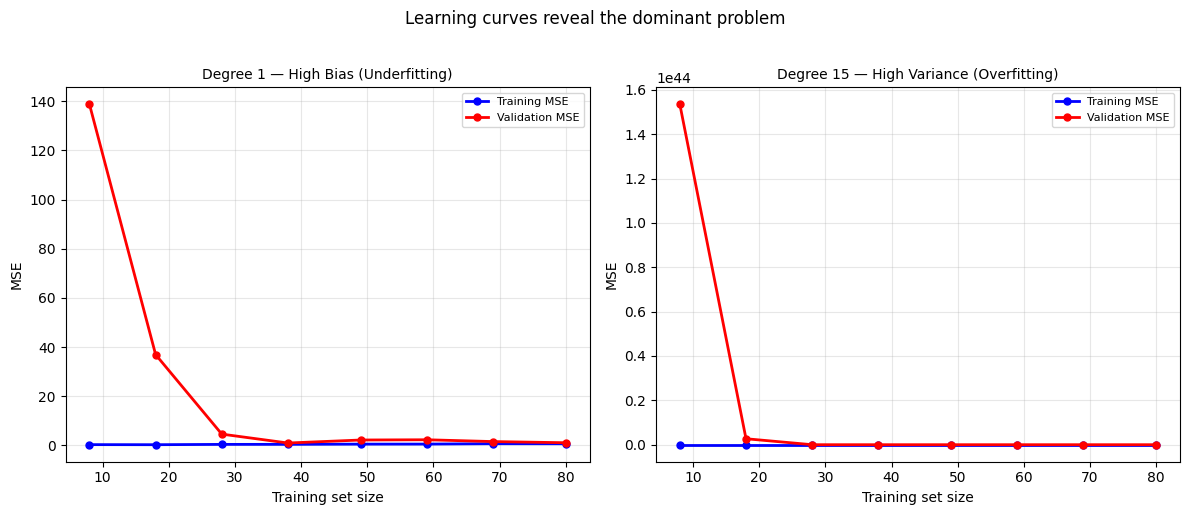
Degree  1:  train MSE=0.646  val MSE=1.057  gap=0.412
Degree 15:  train MSE=0.204  val MSE=1874086326.573  gap=1874086326.369
Train vs Test Error Across Model Complexity
%matplotlib inline
import numpy as np
import matplotlib.pyplot as plt
from sklearn.preprocessing import PolynomialFeatures, StandardScaler
from sklearn.linear_model import LinearRegression
from sklearn.pipeline import make_pipeline
from sklearn.model_selection import train_test_split
from sklearn.metrics import mean_squared_error

np.random.seed(42)
n = 80
X = np.sort(np.random.rand(n) * 10).reshape(-1, 1)
y = np.sin(X).ravel() + np.random.randn(n) * 0.4
X_tr, X_te, y_tr, y_te = train_test_split(X, y, test_size=0.25, random_state=0)

degrees = list(range(1, 18))
tr_errs, te_errs = [], []
for d in degrees:
    pipe = make_pipeline(PolynomialFeatures(d), StandardScaler(), LinearRegression())
    pipe.fit(X_tr, y_tr)
    tr_errs.append(mean_squared_error(y_tr, pipe.predict(X_tr)))
    te_errs.append(mean_squared_error(y_te, pipe.predict(X_te)))

best_d = degrees[np.argmin(te_errs)]

fig, ax = plt.subplots(figsize=(10, 5))
ax.plot(degrees, tr_errs, 'b-o', linewidth=2, markersize=5, label='Training MSE')
ax.plot(degrees, te_errs, 'r-o', linewidth=2, markersize=5, label='Test MSE')
ax.axvline(best_d, color='green', linestyle='--', linewidth=1.5, label=f'Best degree ({best_d})')
ax.set_xlabel('Polynomial degree')
ax.set_ylabel('MSE')
ax.set_title('Train MSE always falls; test MSE forms a U-shape')
ax.legend()
ax.grid(True, alpha=0.3)
plt.tight_layout()
plt.show()

print(f'Optimal degree by test MSE: {best_d}')
/Volumes/MacSSD/01_Projects/Chandravesh-ML-Research/projects/jupyter-books/.venv/lib/python3.10/site-packages/sklearn/linear_model/_base.py:280: RuntimeWarning: divide by zero encountered in matmul
return X @ coef_ + self.intercept_
/Volumes/MacSSD/01_Projects/Chandravesh-ML-Research/projects/jupyter-books/.venv/lib/python3.10/site-packages/sklearn/linear_model/_base.py:280: RuntimeWarning: overflow encountered in matmul
return X @ coef_ + self.intercept_
/Volumes/MacSSD/01_Projects/Chandravesh-ML-Research/projects/jupyter-books/.venv/lib/python3.10/site-packages/sklearn/linear_model/_base.py:280: RuntimeWarning: invalid value encountered in matmul
return X @ coef_ + self.intercept_
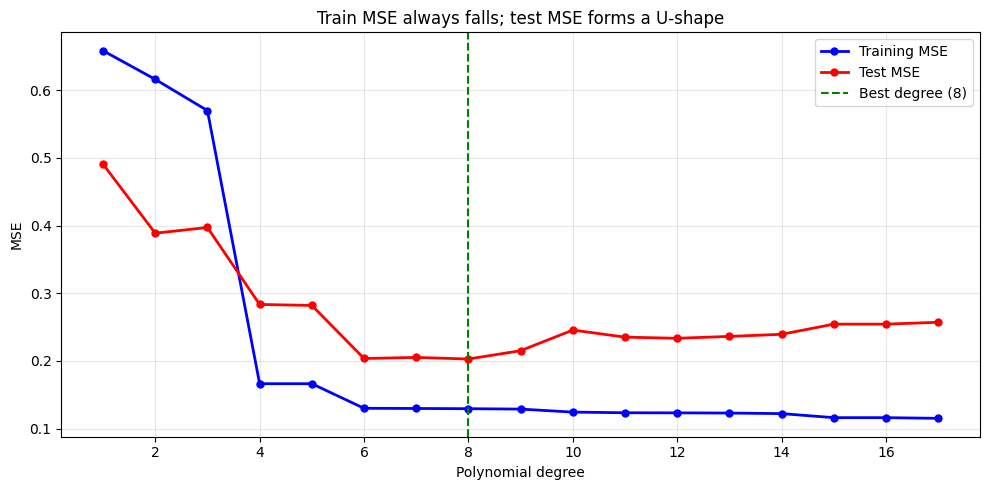
Optimal degree by test MSE: 8
Regularisation as a Variance Reducer
Regularisation does not reduce irreducible error , but it does reduce variance by constraining coefficients:
%matplotlib inline
import numpy as np
import matplotlib.pyplot as plt
from sklearn.linear_model import Ridge
from sklearn.preprocessing import PolynomialFeatures, StandardScaler
from sklearn.pipeline import make_pipeline

def true_func(x): return np.sin(x)

rng = np.random.default_rng(3)
n_boot = 50
X_eval = np.linspace(0, 10, 200).reshape(-1, 1)
y_true = true_func(X_eval.ravel())

fig, axes = plt.subplots(1, 2, figsize=(13, 5), sharey=True)
for ax, alpha, title in [(axes[0], 0.0, 'No regularisation — high variance'),
                          (axes[1], 5.0, 'Ridge alpha=5 — variance reduced')]:
    ax.plot(X_eval, y_true, 'k-', linewidth=2, label='True function', zorder=5)
    all_preds = []
    for _ in range(n_boot):
        n_tr = 30
        Xb = np.sort(rng.uniform(0, 10, n_tr)).reshape(-1, 1)
        yb = true_func(Xb.ravel()) + rng.normal(0, 0.5, n_tr)
        pipe = make_pipeline(PolynomialFeatures(12), StandardScaler(),
                             Ridge(alpha=alpha if alpha > 0 else 1e-10))
        pipe.fit(Xb, yb)
        pred = np.clip(pipe.predict(X_eval), -3, 3)
        all_preds.append(pred)
        ax.plot(X_eval, pred, 'steelblue', alpha=0.12, linewidth=0.8)
    mean_pred = np.array(all_preds).mean(axis=0)
    ax.plot(X_eval, mean_pred, 'orange', linewidth=2.5, label='Mean prediction')
    ax.set_title(title)
    ax.set_ylim(-2.5, 2.5)
    ax.legend(fontsize=8)

plt.suptitle('Degree-12 polynomial: 50 bootstrap fits', y=1.02)
plt.tight_layout()
plt.show()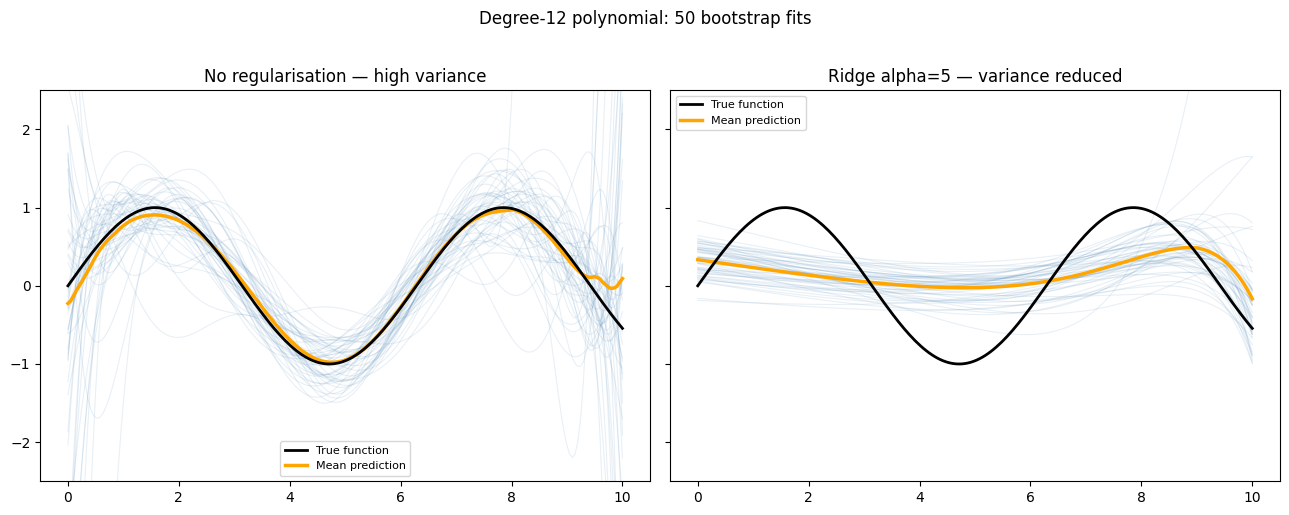
Try It in the Browser
Compute bias and variance manually from a list of bootstrap predictions.
Practical Levers
| Action | Reduces bias | Reduces variance | Notes |
|---|---|---|---|
| Increase model complexity | Yes | No — increases it | Use carefully; pair with regularisation |
| Add regularisation (Ridge/Lasso) | No | Yes | The main tool from the previous notebook |
| Collect more training data | No | Yes | Most reliable variance fix |
| Add informative features | Yes | Slightly | Domain knowledge matters |
| Feature selection / dimensionality reduction | Slightly | Yes | Removes noise dimensions |
| Ensemble methods (bagging) | No | Yes | Average many high-variance models |
| Ensemble methods (boosting) | Yes | Slightly | Stack many high-bias models |
Guided Practice
What usually happens when model bias is high?
What usually indicates high variance?
Collecting more training data primarily helps with which problem?
On a learning curve, you see that both training and validation MSE are high and barely converge as you add more data. What does this indicate?
Exercises
Exercise 1 — Compute the decomposition
Run 50 bootstrap iterations for degree-1, degree-5, and degree-12 polynomial fits on the same dataset. Print a table of , , and total estimated MSE for each degree.
%matplotlib inline
import numpy as np
from sklearn.preprocessing import PolynomialFeatures, StandardScaler
from sklearn.linear_model import LinearRegression
from sklearn.pipeline import make_pipeline

rng = np.random.default_rng(42)
n_train = 30
n_boot  = 50
sigma2  = 0.16   # assumed noise variance

X_eval   = np.linspace(0, 10, 150).reshape(-1, 1)
y_true   = np.sin(X_eval.ravel())

# TODO: for each degree in [1, 5, 12]:
#   run n_boot bootstrap fits
#   compute mean prediction over bootstraps
#   compute bias^2 and variance
#   print a summary table
Hint
for degree in [1, 5, 12]:
    preds = []
    for _ in range(n_boot):
        idx = rng.integers(0, n_train, n_train)
        Xb = np.sort(rng.uniform(0, 10, n_train)).reshape(-1, 1)
        yb = np.sin(Xb.ravel()) + rng.normal(0, 0.4, n_train)
        pipe = make_pipeline(PolynomialFeatures(degree), StandardScaler(), LinearRegression())
        pipe.fit(Xb, yb)
        preds.append(pipe.predict(X_eval))
    preds = np.array(preds)
    mean_p = preds.mean(0)
    bias2 = np.mean((mean_p - y_true)**2)
    var   = np.mean(preds.var(0))
    print(f"d={degree}  bias2={bias2:.4f}  var={var:.4f}  total={bias2+var+sigma2:.4f}")
Exercise 2 — Effect of training size on variance
Fix degree=10. Run the bootstrap decomposition for training sizes [10, 20, 40, 80, 160]. Plot and vs training size and describe what you observe.
# Your code here
Exercise 3 — Regularisation as a variance reducer
Fix degree=12. Run the bootstrap decomposition for Ridge with alpha in [0, 0.1, 1, 10, 100]. Plot how , , and total error change as increases. Explain the tradeoff in 2–3 sentences.
# Your code here
Common Pitfalls
Summary
Key takeaways
| Concept | One-line meaning |
|---|---|
| Bias | Systematic gap between average prediction and truth — underfitting |
| Variance | Prediction instability across training sets — overfitting |
| Irreducible error | Noise floor — no model can beat it |
| Decomposition | |
| U-shape | Total error has a minimum at the optimal complexity |
| Learning curve | Plots train/val error vs data size — diagnoses which problem dominates |
| Fix bias | Increase complexity; add features; reduce regularisation |
| Fix variance | More data; regularise; reduce complexity; use ensembles |
Next Up — Cross-Validation
You can now diagnose bias vs variance. Next: measure generalisation reliably.
The next notebook — Cross-Validation — shows how to estimate test error without wasting data on a fixed holdout set. $k$-fold CV, stratified splits, leave-one-out, and nested CV for hyperparameter tuning all rest on the ideas you just learned about train vs validation error.
Dependencies you already have: train/test split intuition, MSE as evaluation metric, and the insight that a model's test error is the sum of bias, variance, and irreducible noise.