
Naive Bayes
Learning objectives
By the end of this notebook you will be able to:
Apply Bayes’ theorem to derive the posterior class probability from a likelihood and a prior.
Explain the naive conditional independence assumption and why it works in practice.
Implement Gaussian Naive Bayes from scratch using MLE parameter estimation.
Implement Multinomial Naive Bayes with Laplace smoothing for text classification.
Distinguish when to use Gaussian vs Multinomial vs Bernoulli NB.
Compare Naive Bayes (generative) to Logistic Regression (discriminative).
Apply Multinomial NB to spam classification using a bag-of-words representation.
Recognise the zero-frequency problem and fix it with Laplace smoothing.

Business hook — Spam in 4 microseconds
Gmail classifies billions of emails a day. It needs a classifier that is fast to train, fast to predict, and handles millions of word features gracefully. Naive Bayes was the algorithm that powered early spam filters and still runs inside many production text classifiers — not because the independence assumption is correct, but because in high-dimensional spaces the errors cancel and the fast closed-form MLE updates make retraining cheap.
Unlike logistic regression — which models directly (discriminative) — Naive Bayes models the data-generating process and , then inverts with Bayes’ theorem to get the posterior (generative).
1. Bayes’ Theorem
| Term | Name | Meaning |
|---|---|---|
| Posterior | What we want: probability of class given observed features | |
| Likelihood | How likely are these features under class ? | |
| Prior | Class frequency in training data | |
| Evidence | Constant across classes — ignored for classification |
For classification we compare posteriors across classes and pick the largest:
The evidence drops out because it is the same for all classes.
The Naive Assumption
Computing for high-dimensional is intractable — we would need exponentially many joint probability estimates. Naive Bayes assumes conditional independence of features given the class:
This reduces the problem to estimating one-dimensional distributions — easy even with few data points.
2. Gaussian Naive Bayes
When features are continuous, model each class-conditional distribution as a Gaussian:
MLE parameter estimates from training data for class :
Log posterior (for numerical stability):
%matplotlib inline
import numpy as np
import matplotlib.pyplot as plt
from sklearn.datasets import load_iris
from sklearn.model_selection import train_test_split
from sklearn.metrics import accuracy_score

class GaussianNaiveBayes:
    def fit(self, X, y):
        self.classes_ = np.unique(y)
        self.priors_ = {}
        self.means_ = {}
        self.vars_ = {}
        for k in self.classes_:
            X_k = X[y == k]
            self.priors_[k] = len(X_k) / len(X)
            self.means_[k] = X_k.mean(axis=0)
            self.vars_[k] = X_k.var(axis=0) + 1e-9

    def _log_likelihood(self, x, k):
        mu = self.means_[k]
        var = self.vars_[k]
        return -0.5 * np.sum(np.log(2 * np.pi * var) + (x - mu)**2 / var)

    def predict(self, X):
        preds = []
        for x in X:
            log_posts = {k: np.log(self.priors_[k]) + self._log_likelihood(x, k)
                         for k in self.classes_}
            preds.append(max(log_posts, key=log_posts.get))
        return np.array(preds)


iris = load_iris()
X, y = iris.data, iris.target
X_train, X_test, y_train, y_test = train_test_split(X, y, test_size=0.2, random_state=42)

gnb = GaussianNaiveBayes()
gnb.fit(X_train, y_train)
y_pred = gnb.predict(X_test)
print(f'GNB accuracy: {accuracy_score(y_test, y_pred):.4f}')

feature_idx = 2  # petal length
x_range = np.linspace(X[:, feature_idx].min() - 0.5, X[:, feature_idx].max() + 0.5, 300)

plt.figure(figsize=(8, 4))
colors = ['steelblue', 'orange', 'green']
for k, color in zip(gnb.classes_, colors):
    mu = gnb.means_[k][feature_idx]
    sigma = np.sqrt(gnb.vars_[k][feature_idx])
    pdf = (1 / (sigma * np.sqrt(2 * np.pi))) * np.exp(-0.5 * ((x_range - mu) / sigma)**2)
    plt.plot(x_range, pdf, color=color, linewidth=2.5, label=f'Class {k}: {iris.target_names[k]}')
    plt.axvline(mu, color=color, linestyle='--', alpha=0.5)

plt.xlabel(f'{iris.feature_names[feature_idx]}')
plt.ylabel('P(x | class)')
plt.title('Gaussian NB: Class-Conditional Distributions (Petal Length)')
plt.legend()
plt.grid(True)
plt.show()

print('\nLearned class means for each feature:')
for k in gnb.classes_:
    print(f'  {iris.target_names[k]}: {gnb.means_[k].round(2)}')
GNB accuracy: 1.0000
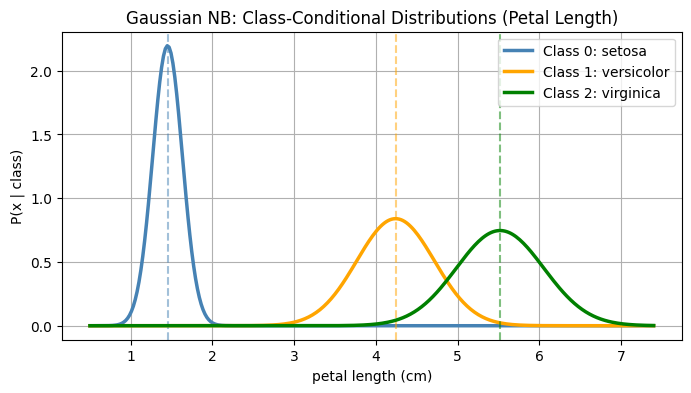
Learned class means for each feature:
  setosa: [4.99 3.45 1.45 0.24]
  versicolor: [5.92 2.77 4.24 1.32]
  virginica: [6.53 2.97 5.52 2.  ]
3. Multinomial Naive Bayes — Text Classification
When features are word counts (bag-of-words), the Multinomial NB models each word in class with a categorical probability:
The likelihood of a document (word count vector) under class :
Zero-frequency problem: if word never appears in class in training, and the entire likelihood collapses to 0 — even if all other words strongly indicate class .
Laplace smoothing fixes this by adding a pseudo-count (default ):
This ensures every word gets a non-zero probability in every class.
Vocabulary representation:
| Method | Vector type | sklearn class |
|---|---|---|
| Bag of words (count) | Integer counts | CountVectorizer + MultinomialNB |
| TF-IDF | Float weights | TfidfVectorizer + ComplementNB |
| Word presence (binary) | 0/1 | CountVectorizer(binary=True) + BernoulliNB |
%matplotlib inline
import numpy as np
import matplotlib.pyplot as plt

class MultinomialNaiveBayes:
    def __init__(self, alpha=1.0):
        self.alpha = alpha

    def fit(self, X, y):
        self.classes_ = np.unique(y)
        n_samples, n_features = X.shape
        self.log_priors_ = {}
        self.log_likelihoods_ = {}
        for k in self.classes_:
            X_k = X[y == k]
            self.log_priors_[k] = np.log(len(X_k) / n_samples)
            word_counts = X_k.sum(axis=0) + self.alpha
            self.log_likelihoods_[k] = np.log(word_counts / word_counts.sum())

    def predict_log_proba(self, X):
        log_proba = np.zeros((len(X), len(self.classes_)))
        for i, k in enumerate(self.classes_):
            log_proba[:, i] = self.log_priors_[k] + X @ self.log_likelihoods_[k]
        return log_proba

    def predict(self, X):
        return self.classes_[np.argmax(self.predict_log_proba(X), axis=1)]


emails = [
    "win a free iPhone today",
    "meeting scheduled at 3pm",
    "earn money working from home",
    "project update attached",
    "free prize winner congratulations",
    "team lunch tomorrow",
    "urgent cash reward offer",
    "report due friday please review",
]
labels = np.array([1, 0, 1, 0, 1, 0, 1, 0])

vocab = sorted(set(w for email in emails for w in email.split()))
word_to_idx = {w: i for i, w in enumerate(vocab)}

X = np.zeros((len(emails), len(vocab)), dtype=float)
for i, email in enumerate(emails):
    for word in email.split():
        X[i, word_to_idx[word]] += 1

mnb = MultinomialNaiveBayes(alpha=1.0)
mnb.fit(X, labels)

test_emails = ["win free cash today", "meeting tomorrow morning"]
X_test = np.zeros((len(test_emails), len(vocab)), dtype=float)
for i, email in enumerate(test_emails):
    for word in email.split():
        if word in word_to_idx:
            X_test[i, word_to_idx[word]] += 1

preds = mnb.predict(X_test)
for email, pred in zip(test_emails, preds):
    print(f'  "{email}" -> {"SPAM" if pred == 1 else "HAM"}')

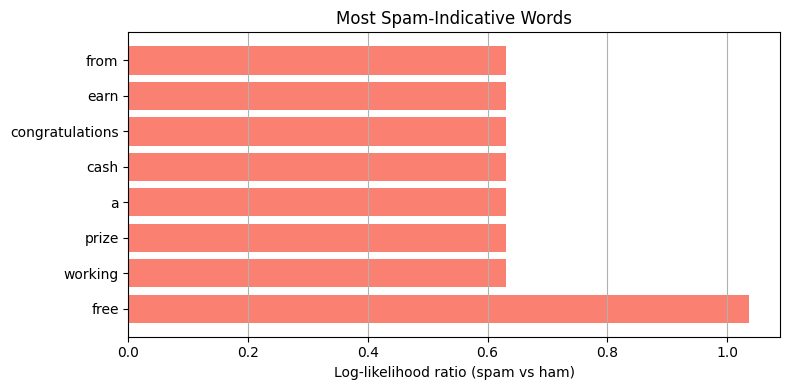
spam_log_ll = mnb.log_likelihoods_[1]
ham_log_ll = mnb.log_likelihoods_[0]
log_ratios = spam_log_ll - ham_log_ll
top_n = 8
top_idx = np.argsort(log_ratios)[-top_n:][::-1]

plt.figure(figsize=(8, 4))
plt.barh([vocab[i] for i in top_idx], log_ratios[top_idx], color='salmon')
plt.xlabel('Log-likelihood ratio (spam vs ham)')
plt.title('Most Spam-Indicative Words')
plt.grid(True, axis='x')
plt.tight_layout()
plt.show()
"win free cash today" -> SPAM
"meeting tomorrow morning" -> HAM
4. Laplace Smoothing — The Zero-Frequency Fix
Without smoothing, if word ‘prize’ never appears in the ham training emails, and the entire posterior collapses:
This is wrong — one unseen word should not make the model impossible.
%matplotlib inline
import numpy as np

counts_spam = np.array([10.0, 5.0, 0.0])  # 'free': 10, 'win': 5, 'prize': 0
counts_ham  = np.array([1.0, 0.0, 3.0])   # 'free': 1, 'win': 0, 'prize': 3
test_doc = np.array([1.0, 1.0, 1.0])

alphas = [0.0, 0.01, 0.1, 1.0]
spam_log_posts, ham_log_posts = [], []

for alpha in alphas:
    spam_probs = (counts_spam + alpha) / (counts_spam.sum() + alpha * len(counts_spam))
    ham_probs  = (counts_ham  + alpha) / (counts_ham.sum()  + alpha * len(counts_ham))
    spam_probs = np.maximum(spam_probs, 1e-300)
    ham_probs  = np.maximum(ham_probs,  1e-300)
    spam_log_posts.append(np.sum(test_doc * np.log(spam_probs)))
    ham_log_posts.append(np.sum(test_doc * np.log(ham_probs)))

print(f'{"alpha":>6} | {"log P(spam)":>12} | {"log P(ham)":>10} | Prediction')
print('-' * 50)
for a, sp, hp in zip(alphas, spam_log_posts, ham_log_posts):
    pred = 'SPAM' if sp > hp else 'HAM' if hp > -1e100 else 'UNDEFINED'
    print(f'{a:6.2f} | {sp:12.4f} | {hp:10.4f} | {pred}')
alpha | log P(spam) | log P(ham) | Prediction
--------------------------------------------------
0.00 | -692.2796 | -692.4495 | SPAM
0.01 | -8.8203 | -7.6746 | HAM
0.10 | -6.5444 | -5.4517 | HAM
1.00 | -4.4815 | -3.7583 | HAM
5. Naive Bayes with scikit-learn
Use sklearn.naive_bayes.MultinomialNB and sklearn.feature_extraction.text.CountVectorizer for a production-grade text pipeline.
%matplotlib inline
import numpy as np
import matplotlib.pyplot as plt
from sklearn.feature_extraction.text import CountVectorizer
from sklearn.naive_bayes import MultinomialNB
from sklearn.model_selection import train_test_split
from sklearn.metrics import accuracy_score, classification_report
from sklearn.pipeline import Pipeline

spam_emails = [
    "win a free iPhone today", "earn money from home fast",
    "urgent cash prize winner", "free gift claim now",
    "limited time offer buy now", "you have been selected winner",
    "get rich quick opportunity", "million dollar lottery prize",
    "free vacation trip winner", "make money online fast",
    "buy cheap medication discount", "click here for free reward",
    "congratulations you won prize", "earn hundreds daily easily",
    "casino bonus free spins",
]
ham_emails = [
    "meeting scheduled for tomorrow", "please review the attached report",
    "team lunch at noon today", "project deadline is next Friday",
    "quarterly review presentation", "budget approval needed soon",
    "conference call at 3pm", "training session next week",
    "office closed on Monday", "interview scheduled for candidate",
    "product roadmap discussion", "sprint retrospective tomorrow",
    "please submit expense report", "client meeting rescheduled",
    "performance review feedback",
]

emails = spam_emails + ham_emails
labels = [1] * len(spam_emails) + [0] * len(ham_emails)

X_train, X_test, y_train, y_test = train_test_split(
    emails, labels, test_size=0.3, random_state=42, stratify=labels
)

pipe = Pipeline([
    ('vect', CountVectorizer()),
    ('clf', MultinomialNB(alpha=1.0)),
])
pipe.fit(X_train, y_train)
y_pred = pipe.predict(X_test)
print('MultinomialNB accuracy:', accuracy_score(y_test, y_pred))
print(classification_report(y_test, y_pred, target_names=['Ham', 'Spam']))

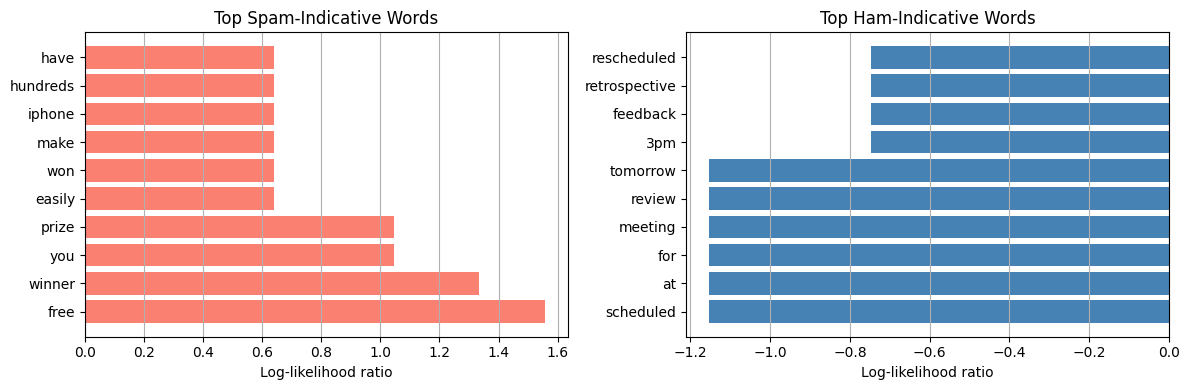
vocab = pipe.named_steps['vect'].get_feature_names_out()
log_probs = pipe.named_steps['clf'].feature_log_prob_
log_ratio = log_probs[1] - log_probs[0]

n = 10
top_spam_idx = np.argsort(log_ratio)[-n:][::-1]
top_ham_idx = np.argsort(log_ratio)[:n]

fig, axes = plt.subplots(1, 2, figsize=(12, 4))
axes[0].barh([vocab[i] for i in top_spam_idx], log_ratio[top_spam_idx], color='salmon')
axes[0].set_title('Top Spam-Indicative Words')
axes[0].set_xlabel('Log-likelihood ratio')
axes[0].grid(True, axis='x')

axes[1].barh([vocab[i] for i in top_ham_idx], log_ratio[top_ham_idx], color='steelblue')
axes[1].set_title('Top Ham-Indicative Words')
axes[1].set_xlabel('Log-likelihood ratio')
axes[1].grid(True, axis='x')

plt.tight_layout()
plt.show()
MultinomialNB accuracy: 0.6666666666666666
precision recall f1-score support
Ham 1.00 0.40 0.57 5
Spam 0.57 1.00 0.73 4
accuracy 0.67 9
macro avg 0.79 0.70 0.65 9
weighted avg 0.81 0.67 0.64 9
6. Generative vs Discriminative — Naive Bayes vs Logistic Regression
| Dimension | Naive Bayes | Logistic Regression |
|---|---|---|
| Approach | Generative: models $P(\mathbf{x} | y)$ |
| Training | Closed-form MLE (one pass) | Iterative gradient descent |
| Speed | Very fast | Slower |
| Data efficiency | Works well with small data | Needs more data to beat NB |
| Feature correlation | Independence assumption hurts | Handles correlated features |
| Probabilities | Often miscalibrated | Better calibrated |
| Text data | Excellent | Good but slower |
Rule of thumb: use NB for small data / text; use LR for larger tabular data where calibration matters.
7. Try It in the Browser
A minimal Gaussian NB in pure Python — adjust training data to see how posteriors change.
import math

def gaussian_pdf(x, mu, sigma2):
    return (1.0 / math.sqrt(2 * math.pi * sigma2)) * math.exp(-0.5 * (x - mu)**2 / sigma2)

# Feature = height_cm, classes = {0: short, 1: tall}
data = [
    (160, 0), (165, 0), (155, 0), (170, 0), (163, 0),
    (185, 1), (180, 1), (190, 1), (175, 1), (183, 1),
]

classes = [0, 1]
params = {}
for k in classes:
    vals = [x for x, y in data if y == k]
    mu = sum(vals) / len(vals)
    var = sum((v - mu)**2 for v in vals) / len(vals) + 1e-6
    prior = len(vals) / len(data)
    params[k] = {'mu': mu, 'var': var, 'prior': prior}

x_new = 172
log_posts = {}
for k in classes:
    ll = math.log(gaussian_pdf(x_new, params[k]['mu'], params[k]['var']) + 1e-300)
    log_posts[k] = math.log(params[k]['prior']) + ll

print(f'Predicting for x = {x_new} cm')
print(f'  Class 0 (short): log-posterior = {log_posts[0]:.4f}')
print(f'  Class 1 (tall):  log-posterior = {log_posts[1]:.4f}')
pred = max(log_posts, key=log_posts.get)
print(f'  Prediction: {"tall" if pred == 1 else "short"}')
Knowledge Check
Why is Naive Bayes called "naive"?
In what kind of setting can Naive Bayes perform surprisingly well?
What does Laplace smoothing fix in Multinomial Naive Bayes?
When computing the MAP decision rule, why is the evidence P(x) ignored?
Exercises
Exercise 1 — Gaussian NB on Wine Dataset
Load the wine dataset from sklearn. Fit your GaussianNaiveBayes class and compute test accuracy. Compare to sklearn’s GaussianNB. Do the results match?
%matplotlib inline
# Exercise 1: Gaussian NB on wine dataset
# Your code here
Exercise 2 — Smoothing Strength
Using the spam pipeline above, sweep alpha over [0.001, 0.01, 0.1, 1.0, 10.0] and plot test accuracy vs alpha. Does more smoothing always help?
%matplotlib inline
# Exercise 2: Laplace smoothing sweep
# Your code here
Common Pitfalls
Summary
Bayes’ theorem: . The evidence cancels in the argmax.
Naive assumption: — reduces joint distribution to one-dimensional distributions.
Gaussian NB: MLE estimates , per class per feature; use log-posteriors for numerical stability.
Multinomial NB: word count likelihoods; Laplace smoothing () prevents zero-frequency collapse.
Generative vs discriminative: NB converges faster with small data; LR achieves lower error with large data.
Use NB for text (fast, interpretable); use LR when feature correlation matters or calibration is needed.

What’s Next?
Both logistic regression and Naive Bayes assume the training data is representative — but real business datasets are often severely class-imbalanced (e.g., 1 % fraud, 99 % legitimate). In class_imbalance.ipynb we tackle calibration, SMOTE, class weights, and how to evaluate imbalanced classifiers correctly.
Coming up:
Calibration & Class Imbalance — reliability diagrams, SMOTE, cost-sensitive learning
Classification Metrics — precision, recall, F1, AUC-ROC, AUC-PR in depth
Lab — Churn Prediction end-to-end pipeline